

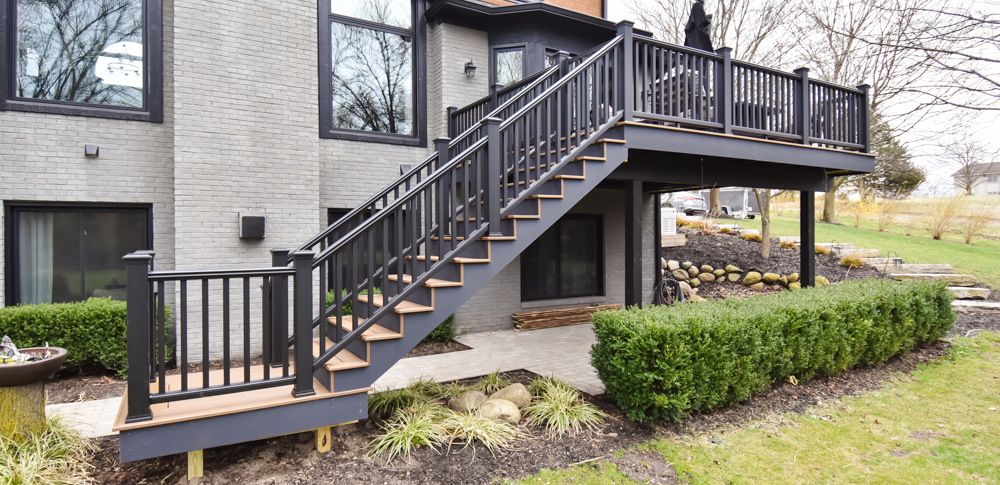
2026 Deck Design Trends — and Our Opinions on Them
Highlights from this Article:
- Several 2026 trends are genuinely worth paying attention to: mixed materials, built-in lighting, warmer color palettes, and minimalist railings all make good sense for Michigan homes.
- Outdoor kitchens are popular for a reason, but they require careful structural planning and attention to design that allows for future flexibility.
- Multi-level decks are having a moment — but we think they deserve more scrutiny than they’re getting. They cost significantly more and aren’t the right fit for every yard or budget.
- The best deck is the one that suits your home, your yard, and how you actually live — not the one that was trending when you built it.
Skip down to the quick comparison table or the FAQs.
Every year, design publications and building industry sources publish their lists of what’s trending in outdoor living. Some of it is genuinely useful. Some of it is marketing dressed up as editorial. And some of it looks great in a photo shoot but raises real questions when you’re the one who has to build it, maintain it, and live with it through a Michigan winter.
We’ve been building decks in the Ann Arbor area since 2006. Here’s our take on what’s actually worth your attention in 2026 — and one trend we’d encourage you to think twice about.
Trend 1: Warmer, More Natural Color Palettes
Our take: We like this one.
The era of stark cool gray decks appears to be winding down. The 2026 color story in decking is trending toward warmer earth tones: cedar browns, soft tawny neutrals, driftwood-inspired hues, and warm wood-like finishes that complement natural landscaping rather than contrasting with it.
For Michigan homes, this makes a lot of sense. Our yards tend toward greenery, mature trees, and natural stone — and warm-toned decking integrates with that environment very gracefully. Trex, TimberTech, and other composite manufacturers have all expanded their warm-tone offerings, and the quality of the wood-grain texture simulation has improved considerably in recent years.
One practical note: lighter neutrals also tend to retain less surface heat in summer than very dark boards, which is worth keeping in mind if your deck gets direct afternoon sun.
Trend 2: Mixed Materials
Our take: One of our favorites.
Mixing decking materials (main decking in one color with picture-frame edges in a different color, composite decks with cedar pergolas or cedar privacy walls, or natural wood decks with composite or metal rails) is a trend we’re genuinely enthusiastic about.
Done well, mixing materials adds depth and visual interest without adding clutter, and it lets homeowners personalize a deck in ways that feel designed rather than default. Often, homeowners coordinate deck fascia with house trim color for a built-in look, while using a lighter color for the main deck to keep the surface cool, light and airy-looking. We still really love single-color decks, though, because they always look classic.
Trend 3: Minimalist Railings
Our take: Well suited to Michigan homes.
Clean, low-profile railing systems that preserve sightlines rather than interrupting them are having a strong moment in 2026 — cable railing, glass panels, and slim aluminum balusters that largely disappear from view. We think this trend suits Michigan homes particularly well.
Most of our clients have yards worth looking at: mature trees, gardens, open green space. A heavy traditional railing system cuts all of that into horizontal slices. Minimalist railing keeps the view intact and gives a deck a more open, airy feeling that suits the way people actually use outdoor space in warmer months.
If you’re interested in glass railing systems specifically, we published a detailed post on what to consider for Michigan’s climate — including airflow, hardware, and maintenance — which is worth reading before you decide.
Trend 4: Built-In Lighting
Our take: A smart long-term investment.
Low-voltage LED lighting integrated into rails and stairs has been growing for several years and shows no sign of slowing. In 2026, it’s becoming less of an upgrade and more of an expectation on mid-to-upper-range deck builds.
We think the trend has earned its momentum. Built-in deck lighting extends the usable hours of your outdoor space into evenings, improves safety on stairs and transitions, and adds ambiance that’s difficult to replicate with freestanding fixtures. The LED systems available today are energy-efficient, durable, and designed to handle Michigan’s temperature swings without issue. Transformers and remotes allow for automated features like turning the lights on at dusk and off at dawn, for instance.
For those looking to light up rail post caps with minimal fuss, Trex now offers a solar post cap light that needs no transformer or wiring system.
The time to plan for lighting is during the build, not after. Adding or moving an exterior electrical plug, running wiring and positioning fixtures is straightforward when the deck is under construction; retrofitting lighting into an existing deck may be considerably more involved. If you’re planning a new deck or a full resurfacing project, it’s worth a conversation about lighting at the design stage. We will design a lighting plan for you and include it as an optional line item on your project proposal.
Trend 5: Outdoor Kitchens
Our take: Great idea, but plan it carefully.
Outdoor kitchens — built-in grills, countertops, refrigerators, and prep areas — are consistently one of the most requested features in 2026 outdoor living design. We understand why. A well-executed outdoor kitchen turns a deck and patio into a genuine destination for entertaining.
Our measured note here: A fully equipped outdoor kitchen setup — stone or concrete countertops, appliances, cabinetry, and plumbing — means multiple immovable objects in your backyard space, so it does require an ample back yard. If you’re planning an outdoor kitchen, we suggest including only the features you absolutely know you will use for decades to come. A strong outdoor kitchen design also includes weather protection and a plan for security. Be prepared as well for the maintenance that an outdoor kitchen requires.
Trend 6: Multi-Level Decks
Our take: Proceed thoughtfully.
Multi-level decks — platforms at different elevations connected by steps, creating separate zones for dining, lounging, and entertaining — are being promoted heavily in 2026 design coverage as a way to add architectural interest and functional zones to a backyard.
There are situations where a multi-level deck is clearly the right answer: a yard with significant grade changes, a house with doors at different levels, or a need to create genuinely distinct outdoor rooms, for example.
However, if a well-designed single-level deck with thoughtful zoning (defined by furniture arrangement, a pergola, or a change in decking pattern) would serve you just as well, that’s often the smarter long-term investment. Just think about how many steps you can navigate holding a tray of drinks, or how your aging parents might handle the level changes when they come over for a party. You may also want to change the furniture or function at a later date, only to discover that the various deck levels are the wrong sizes for your new plans.
We’ll speak with you honestly about which approach makes more sense for your specific yard and goals. That’s a more useful conversation than simply following what’s in style.
Bonus Trend: Prefabricated Pergolas with Retractable Canopies
Our take: The trend nobody’s writing about — but should be.
You won’t find this one on many 2026 trend lists, but we’re seeing it consistently in our own work: more and more homeowners are adding prefabricated pergolas with retractable canopies to their decks, and the results are genuinely impressive.
The appeal is straightforward. A pergola with a retractable canopy gives you the best of both worlds — open sky when you want it, shade and weather protection when you don’t — without the permanence or cost of a full four-season room addition. Close the canopy on a clear, warm evening; draw it over when the afternoon sun gets punishing or a summer storm rolls in. For Michigan’s famously variable weather, that flexibility is genuinely valuable.
We can design and build a custom pergola for you. We’ve also been installing Trex Pergolas in particular and have been impressed with the product. The structures use a cellular PVC exterior wrapped around a structural aluminum core, which means they’re strong, low-maintenance, and won’t rot, warp, or split. The canopy systems — Trex offers both manual and motorized retractable options — come in a range of fabrics including Sunbrella and airflow mesh, with enough color choices to coordinate with most deck surfaces. The whole line is backed by a 25-year structural warranty, which is about as confident as a manufacturer gets.
A few things worth knowing if you’re considering one. First, the pergola needs to be sized and positioned relative to the deck during the planning phase — it’s much cleaner to integrate it as part of a new build or a resurfacing project than to add it afterward. Second, if you want built-in lighting or a ceiling fan (both available as add-ons for some Trex Pergolas), we can plan the electrical during the deck build rather than retrofitting it later. Third, a pergola adds a meaningful amount of wind load to the deck structure, so we assess the framing before installation on existing decks.
This is a trend driven by real homeowner behavior rather than design press coverage, which is often the best kind.
2026 Deck Trends at a Glance
| Trend | Our Take | Best For |
|---|---|---|
| Warmer color palettes | We like it | Most Michigan homes and yards |
| Mixed materials | One of our favorites | Homeowners who want a personalized, designed look |
| Minimalist railings | Well suited to Michigan | Yards with views or greenery worth preserving |
| Built-in lighting | Smart long-term investment | Any new build or full resurfacing project |
| Outdoor kitchens | Great, with caveats | New builds or decks with sound structural framing |
| Multi-level decks | Proceed thoughtfully | Sloped yards or projects with generous budgets |
| Prefabricated pergola + retractable canopy | Highly recommended | Any deck where shade and weather flexibility matter |
Frequently Asked Questions
Should I design my deck around current trends? Trends are a useful starting point for thinking about what you might want, but the best deck is the one that suits your home, your yard, and how you actually use outdoor space — not the one that was popular when you built it. We try to help clients separate the trends that have genuine staying power from the ones that may look dated in five years.
Are warmer deck colors harder to keep clean than gray? Not meaningfully. Modern composite finishes in warmer tones are engineered with the same stain and fade resistance as any other color in the lineup. The bigger practical variable is surface heat: very dark boards in full sun get noticeably hot underfoot in summer, which is worth considering regardless of the specific color.
How much more does a multi-level deck cost compared to a single-level deck? It varies by project, but as a rough orientation, a multi-level deck typically costs 20 to 30 percent more than a single-level deck of equivalent total square footage, due to the additional framing complexity, materials, and labor involved in each elevation change. The best way to understand the cost difference for your specific project is to get quotes for both options side by side.
Is built-in lighting something I can add later, or does it need to be planned from the start? It’s much more straightforward to integrate during the build. Running low-voltage wiring through posts and under the deck framing is simple when the deck is under construction; retrofitting it into an existing deck means opening up sections of the structure to route wiring, which adds time and cost. Also, you need an outdoor plug in a handy place for the lighting transformer. If a plug needs to be installed or moved, that’s best done before the deck frame goes in.
Let’s Design Something Worth Building
If you’re thinking about a new deck or a significant upgrade and want to talk through which 2026 trends make sense for your specific home and yard, we’d enjoy that conversation. Our free on-site consultations take about 45 to 60 minutes and come with no obligation.
Book your free estimate today. We’ll give you our honest read on what’s worth doing — and what isn’t.