

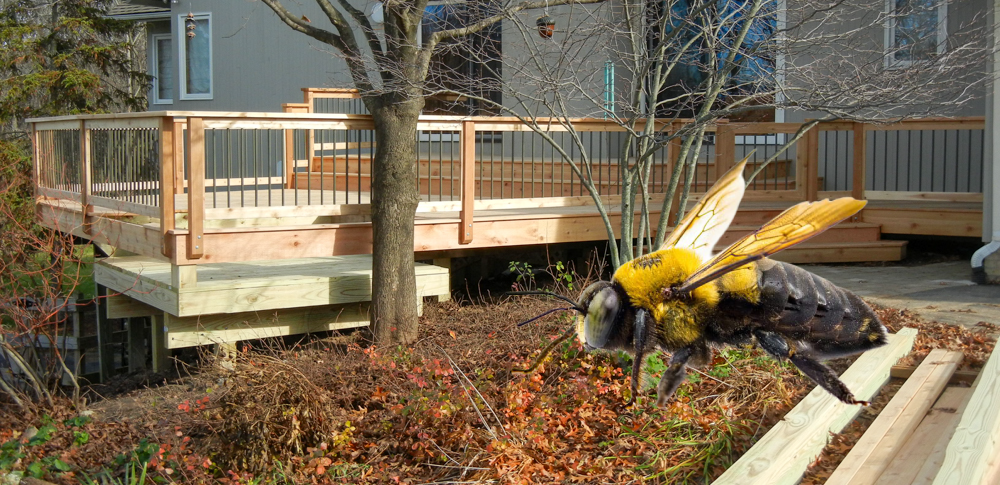
Carpenter Bees Damaging Your Old Wood Deck or Gazebo? Here Are Some Solutions.
Highlights from this Article:
- Carpenter bee damage to cedar decks, railings, posts, and gazebos is increasingly common across Washtenaw County. Our crew sees it on job sites year-round.
- Unsealed, unpainted, or weathered cedar is the most vulnerable. Properly finished wood is significantly more resistant.
- Damage often goes unaddressed for months or years. By which point the structural impact can be serious.
- Composite decking is immune to carpenter bees. For homeowners who’ve dealt with repeated damage, resurfacing with composite is often the right long-term answer.
Skip down to the wood vs. composite comparison or the FAQs.
Our owner, Josiah Shurtliff, has been building decks in the Ann Arbor area since 2006. Over the past several years, he and our crew have noticed a pattern that’s hard to ignore. Carpenter bee damage to wood decks, railings, posts, and backyard structures is showing up more frequently, and by the time most homeowners call us, it’s been going on longer than they realized.
Here’s how to recognize carpenter bee damage, why cedar is particularly vulnerable, what it means for your deck structurally, and what your options are when you find damage.
What Carpenter Bees Actually Do
Carpenter bees are large, heavy-bodied bees that look similar to bumblebees. Unlike bumblebees, they don’t live in colonies. The females bore into wood to create individual nesting galleries. The entry hole is almost perfectly round, about half an inch in diameter (the size of a small coin, and typically appears on the underside or end grain of a board where it’s less exposed to weather.
Once inside, the bee turns and tunnels with the grain of the wood, sometimes extending several feet. That tunnel becomes a nesting chamber. The momma bee lays eggs, seals the chamber, and the next generation emerges the following spring, often returning to the same structure to bore new tunnels nearby. Year after year, the damage compounds.
There’s a secondary damage problem that many homeowners don’t know about: woodpeckers. Once carpenter bee larvae are established inside a piece of wood, woodpeckers will hammer into it to get at them. A post or railing that a carpenter bee has been working on for a season or two can end up looking like it lost a fight with a power drill (holes, splits, and splintered wood that goes well beyond the original bee entry points).
Why Cedar Is So Vulnerable
Cedar is a beautiful decking material and naturally rot-resistant, but it has a well-known vulnerability to carpenter bees: when it’s left bare, weathered, or inadequately finished, it’s one of their preferred targets. Carpenter bees strongly prefer untreated, unpainted, unfinished softwood, and cedar that hasn’t been properly sealed, stained, or painted is essentially an open invitation.
This is something Josiah and our crew see repeatedly on assessments. A homeowner puts in a cedar deck, enjoys it for a season or two, and either skips the initial finishing or lets it lapse. Within a few years, the railings and posts are dotted with entry holes. By the time we’re called out, the damage has often spread well beyond the surface boards into the posts and structural framing, components that are harder and more expensive to replace than decking or fascia.
Pressure-treated pine is less attractive to carpenter bees due to the chemical treatment, but it’s not entirely immune, particularly on older decks where the treatment has weathered and the wood has dried out and cracked.
Why Homeowners Often Don’t Act Quickly
We get carpenter bee damage calls year-round, but the actual damage happens in spring when female bees are most active. The reason we hear from homeowners in every season is that most people don’t act on it right away.
Part of that is the nature of the damage itself. The entry holes are small and sometimes in locations that aren’t immediately obvious (on the underside of a rail cap, at the base of a post, on the fascia boards that frame the deck’s edge). A homeowner might notice a hole or two, assume it’s minor, and intend to deal with it later. Meanwhile the bees are extending their tunnels, laying eggs, and the woodpeckers are following.
By the time “later” arrives, what might have been a resurfacing project has become a structural repair or a full replacement. We’re not saying this to alarm anyone. We’re saying it because catching damage early genuinely matters, and we’d rather see people act on it sooner than wait.
What We Find on Assessments
When we’re called out for a consultation, here’s what we’re looking at:
- Deck boards and railings: Entry holes, surface damage, and softness or sponginess in the wood around affected areas.
- Posts: Posts are a particular concern because they’re structural. A post that’s been extensively tunneled can lose significant load-bearing capacity. We probe posts carefully, especially at the base and cap where bees tend to concentrate.
- Ledger board and framing: If bees have been active long enough, we check whether the damage has reached the framing. This is where things get more serious structurally.
- Gazebos and pergolas: We’re seeing a lot of carpenter bee damage on gazebos and wood pergolas, particularly on exposed rafter tails, posts, and any bare cedar or pine components. These structures often get less maintenance attention than the main deck.
Your Options When You Find Damage
Full Resurfacing with Composite
For homeowners who have dealt with significant carpenter bee damage, or who simply don’t want to deal with the ongoing maintenance and vulnerability of wood, resurfacing with composite decking is the most permanent solution. Composite boards are made from wood fiber and plastic; carpenter bees have no interest in boring into them. A composite deck surface, composite or PVC railings, and properly treated or composite post systems eliminate the carpenter bee problem for the life of the deck.
We’ve done a number of these projects in Washtenaw County where the trigger was exactly this: a cedar deck with recurring carpenter bee damage, a homeowner who’s tired of fighting it, and a decision to resurface with composite once and not think about it again. It’s a sound investment, particularly when the framing is still in good shape and a full replacement isn’t necessary.
Repair and Refinish the Existing Wood
Where the damage is caught early and the structural framing is sound, homeowners can replace damaged boards, repair or replace affected posts, fill existing holes, and refinish the wood with a quality paint or solid stain. Properly finished cedar (well-sealed and maintained) is significantly more resistant to carpenter bees than bare or weathered wood.
This is a viable path, but it comes with an honest caveat: it requires follow-through on maintenance. If the deck goes bare again, the bees will be back. We’ll tell you this plainly when we give you your options.
Wood vs. Composite: Carpenter Bee Vulnerability at a Glance
| Bare or Weathered Cedar | Properly Finished Cedar | Composite Decking | |
|---|---|---|---|
| Carpenter bee risk | High | Moderate (requires upkeep) | None |
| Maintenance required | Immediate | Regular sealing and staining | Minimal |
| Structural risk if ignored | Significant over time | Lower with proper maintenance | Not applicable |
| Long-term solution | No | Only with consistent upkeep | Yes |
Frequently Asked Questions
How do I know if I have carpenter bee damage? Look for round entry holes approximately half an inch in diameter, typically on the underside of horizontal boards, the tops of rail caps, or the faces of posts. You may also see coarse sawdust (called frass) below entry points, or yellow staining from bee waste near holes. If woodpeckers have been active on your deck or pergola, that’s another strong indicator. They’re usually following the bees.
Are carpenter bees dangerous to people? Generally no. Male carpenter bees can be territorial and will hover aggressively near their nesting sites, but they have no stinger. Female carpenter bees do have stingers but are docile and rarely sting unless directly handled. The danger is to your wood structures, not to you.
Can I treat the existing holes myself? You can fill holes with wood filler or steel wool and caulk as a temporary measure, and insecticide dust applied to active holes in spring can kill larvae before they emerge. But DIY treatment addresses the symptom, not the underlying vulnerability. Bare, unfinished wood will attract new bees the following season. If the damage is more than superficial, a professional assessment is worth it.
Does composite decking really eliminate the problem? For the deck surface and composite or PVC railing components, yes. Carpenter bees bore into wood fiber; they have no interest in composite or PVC materials. If your post system uses wood posts (even on a composite deck), those should be addressed. We can discuss post options during a consultation.
How quickly does carpenter bee damage become a structural problem? It depends on the scope of activity and how long it’s been going on. A single season of moderate activity on a few boards is usually a surface issue. Several seasons of heavy activity on posts or framing members can meaningfully compromise structural integrity. This is why we encourage homeowners not to wait once they notice it.
Is this a problem specific to the Ann Arbor area? Carpenter bees are common throughout the eastern United States, but our crew has noticed an uptick in damage calls across Washtenaw County over the past several years. Whether that reflects a growing bee population, more wood decks reaching the age where unsealed wood becomes attractive, or simply greater awareness, we can’t say for certain. What we can say is that it’s a real and growing part of what we’re seeing on assessments in this area.
Think You Might Have Carpenter Bee Damage?
If you’ve noticed holes in your deck railings, posts, or backyard structures, it’s worth having someone take a look before the next spring season brings another round of activity. Our free on-site assessments take about 30 to 45 minutes, and we’ll give you a clear, honest picture of what we find along with your options.
Book your free assessment today. We serve Ann Arbor, Saline, Dexter, Chelsea, Pittsfield Township, Ypsilanti, and the surrounding Washtenaw County area.