

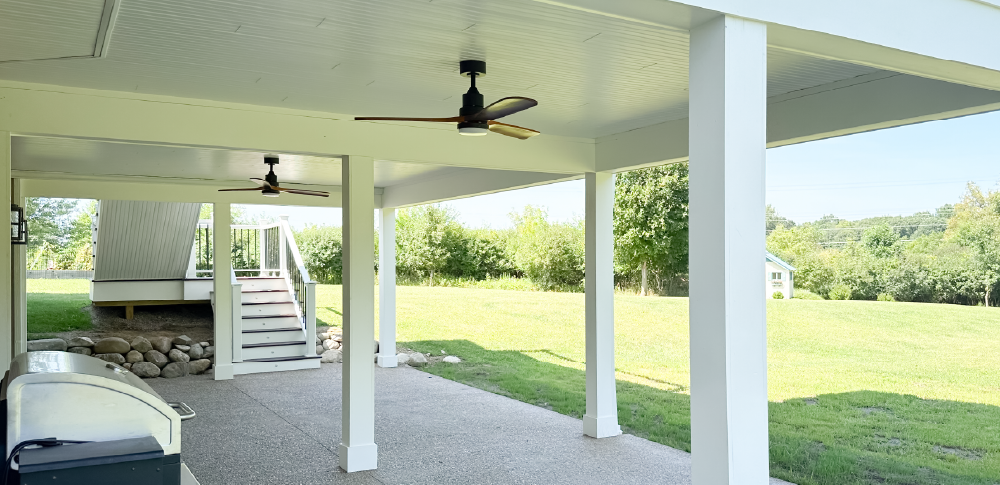
Under-Deck Drainage: Doubling Your Outdoor Living Space on an Elevated Deck
Highlights from this Article:
- An under-deck drainage system collects rainwater as it drains between deck boards and channels it away, keeping the area below the deck completely dry.
- Ann Arbor Decks installs both Trex RainEscape and TimberTech DrySpace, two systems with meaningfully different installation approaches.
- Trex RainEscape installs over the joists before decking goes down; it cannot be added to an existing deck without removing the boards. TimberTech DrySpace installs under the joists and can be retrofitted to most existing elevated decks.
- Both systems protect the framing from moisture, extending the life of the deck’s structural components.
- Once the drainage system is in place, the space below can be finished with a vinyl beaded ceiling, lighting, ceiling fans, or left open with the drainage system visible.
Skip down to the system comparison table or the FAQs.
Most homeowners don’t think much about what happens under their elevated deck when it rains. Water passes through the gaps between deck boards, drips onto the joists and framing, saturates the space below, and generally makes the area unusable during and after any precipitation. On a second-story deck over a walkout basement, that means a lower patio that’s wet and muddy whenever the weather turns. On a higher first-floor deck, it means a storage or entertaining area that gets rained on just as much as the surface above.
An under-deck drainage system changes that equation completely. Instead of letting water fall through onto everything below, the system catches it at the framing level and channels it away through a network of troughs, panels, and downspouts, leaving the space below clean, dry, and genuinely usable in almost any weather.
Why You’d Want Under-Deck Drainage
The most obvious reason is usability. A dry under-deck space is a legitimate outdoor room. Depending on the height clearance below your deck, it can accommodate outdoor furniture, a dining or lounge area, a grill station, an outdoor kitchen, a hot tub surround, or simply a protected storage area that stays dry year-round. In Michigan, where spring and fall weather can be unpredictable, having a rain-protected outdoor space extends the season meaningfully.
There’s also a structural benefit that often goes unmentioned. An over-the-joist drainage system (like Trex RainEscape) creates a barrier above the framing that keeps moisture off the joists and beams entirely. Pressure-treated lumber, even quality material, has a finite lifespan when it’s repeatedly wetted and dried over years of Michigan weather. A system that keeps the framing dry from the start can significantly extend the structural life of the deck. For a composite deck surface that carries a 25- to 50-year warranty, protecting the wood substructure that supports it is a worthwhile investment.
The Two Systems We Install
Trex RainEscape
Trex RainEscape is an over-the-joist system. Before the deck boards go down, a network of flexible HDPE troughs is laid across the top of each joist bay (the space between joists), and downspouts are positioned to carry water from the troughs down and away from the structure. Butyl tape seals all seams and surrounds fasteners to prevent any water from reaching the framing below. Once the drainage system is in place and tested, the deck boards are installed on top of it.
Because RainEscape sits above the joists, it creates a true moisture barrier for the entire substructure. The joists and framing never see rain at all. The system is available in brown or black to coordinate with the decking above, and Trex offers plug-and-play LED soffit lights that install directly into the RainEscape ceiling from below, making the lighting integration clean and straightforward.
The significant constraint of RainEscape is that it must be installed during the build, before decking goes down. It cannot be added to an existing deck without removing all of the deck boards first. For new deck construction, it’s an excellent system. For an existing elevated deck, it requires either a full resurfacing project (which gives us access to the joists) or a different approach altogether.
TimberTech DrySpace
TimberTech DrySpace takes the opposite approach. Instead of sitting above the joists, DrySpace installs beneath them, attaching to the underside of the deck framing from below. The system uses interlocking V-shaped vinyl panels that snap into brackets secured to the joists, creating a sloped drainage surface that channels water away from the house. The pitch of the system (1/8 inch per foot) ensures consistent drainage toward the gutter or downspout at the perimeter.
The key advantage of DrySpace is that it can be installed on most existing elevated decks without removing a single deck board. As long as there is access from below (which is nearly always the case on an elevated deck), DrySpace can be retrofitted to the existing framing. This makes it the right choice for homeowners who already have an elevated deck in good structural condition and want to add drainage and a finished ceiling without undertaking a full resurfacing project.
DrySpace is made of solid extruded vinyl, is available in Bone and White, and comes with a 25-year limited warranty. The system works with 12-inch and 16-inch on-center joist spacing. It is designed to work with an external gutter at the perimeter to carry water away from the structure.
Can You Add Drainage to an Existing Deck Without Removing the Boards?
Yes, but only with the right system. This is one of the most common questions we get on this topic, and the answer depends entirely on which system you’re considering.
Trex RainEscape requires access to the tops of the joists, which means the deck boards have to come off. If your existing deck is due for a resurfacing anyway (the boards are worn, the surface is tired, or you’re ready for composite), a resurfacing project combined with RainEscape installation is a natural pairing. We access the joists during the resurfacing, install RainEscape before the new boards go down, and you end up with both a new deck surface and a fully functioning drainage system in one project.
TimberTech DrySpace, by contrast, is specifically designed for both new and existing decks. It installs entirely from below. If your deck structure is sound and you’re happy with the surface, DrySpace can be added without disturbing a single board above. We assess the framing from below, confirm the joist spacing and structural condition, and install the system from the underside. This is the practical path for most existing decks where a full resurfacing isn’t otherwise warranted.
Trex RainEscape vs. TimberTech DrySpace at a Glance
| Trex RainEscape | TimberTech DrySpace | |
|---|---|---|
| Installation position | Over the joists (above framing) | Under the joists (below framing) |
| New deck installation | Yes | Yes |
| Existing deck retrofit | Only if deck boards are removed | Yes, without removing deck boards |
| Protects framing from moisture | Yes (complete barrier above joists) | Partial (water still contacts joists before draining) |
| Material | HDPE trough and downspout system with butyl tape sealing | Solid extruded vinyl V-panels with bracket system |
| Colors | Brown or Black | Bone or White |
| Integrated lighting option | Yes (Trex plug-and-play soffit lights) | Via finished ceiling added below |
| Warranty | 25 years | 25 years |
Finishing the Space Below
Once the drainage system is in place, you have choices about how to finish the underside of the deck. The right approach depends on how you intend to use the space, how much you want to invest in finishing, and personal preference.
Leave the Drainage System Exposed
Both RainEscape and DrySpace are reasonably clean-looking systems. RainEscape’s brown or black troughs, viewed from below, give the ceiling a structured, industrial-adjacent look that some homeowners find appealing as-is. DrySpace’s white or bone vinyl panels create a clean, light-colored surface that reads almost like a simple ceiling without any additional finishing. For storage areas or utilitarian spaces, leaving the drainage system visible is a perfectly practical choice that keeps costs lower and installation simpler.
Vinyl Beaded Ceiling
For a more finished look (particularly in spaces intended for outdoor dining, lounging, or entertaining), a vinyl beaded ceiling installed below the drainage system is the most popular upgrade. Beaded vinyl ceiling panels give the under-deck space the feel of a covered porch, with a clean, consistent surface that hides the framing and drainage components completely. The combination of a drainage system above and a finished ceiling below creates what is effectively an outdoor room. Vinyl is the right material for this application because it won’t warp, rot, or absorb moisture the way wood would in an outdoor environment.
Lighting
A drainage system creates the infrastructure for safe under-deck lighting, since the ceiling area is dry and protected from above. Trex offers plug-and-play LED soffit lights that integrate directly with the RainEscape system; they install into the trough ceiling from below using spring clips and connect to Trex’s standard low-voltage system. For DrySpace installations, or where a vinyl beaded ceiling is added, recessed or surface-mounted outdoor-rated fixtures can be installed in the finished ceiling. Lighting transforms an under-deck space from a daytime-only storage area into an evening entertaining space and is one of the most impactful upgrades available at a relatively modest cost.
Ceiling Fan
On an elevated deck with reasonable clearance below (typically eight feet or more), a ceiling fan rated for damp or wet outdoor use can be mounted to the deck framing or a finished ceiling below. In Michigan summers, a ceiling fan makes a significant difference in comfort, particularly in humid weather or in south- and west-facing spaces that collect afternoon heat. If a ceiling fan is part of your plan, electrical rough-in needs to be coordinated during the construction phase. This is one of those details that is straightforward to plan for during the build and much more disruptive to add after the fact.
Frequently Asked Questions
Does my deck need to be elevated to use an under-deck drainage system? Yes, in a practical sense. These systems create a dry space below the deck, so there needs to be a meaningful “below” (a patio, walkout basement level, or storage area) that benefits from being kept dry. Ground-level decks don’t have this space and don’t need drainage systems for the same reasons. Elevated decks, second-story decks over walkout basements, and decks with significant clearance below are the right candidates.
How high does my deck need to be for an under-deck system to make sense? There’s no strict minimum, but practically speaking, a deck needs enough clearance for the space below to be useful. Five feet of clearance provides storage utility; seven or more feet opens up genuine living space with room for furniture, a fan, and lighting. We’ll assess the clearance during our consultation and help you determine whether a drainage system makes sense for your specific deck.
Will a drainage system change the look of my deck from above? Not with either system. RainEscape sits between and over the joists, invisible once decking is installed. DrySpace is installed entirely from below and has no effect on the deck surface whatsoever.
How does water exit the system? Both systems direct water to a gutter or downspout at the perimeter of the deck, which carries it away from the structure. RainEscape uses integrated downspouts built into the trough system; DrySpace directs water to a gutter attached at the perimeter. In both cases, the water exits in a controlled location rather than dripping randomly across the area below.
Can I add a ceiling fan to the under-deck space? Yes, provided there’s adequate clearance and electrical access. The fan needs to be rated for outdoor damp or wet locations, and the electrical wiring needs to be properly installed. We coordinate this through our electrician for projects where a fan is part of the plan. If you think you might want a fan at some point, it’s worth discussing during the design phase so wiring can be roughed in ahead of time.
Does under-deck drainage require a permit? Generally not for the drainage system itself, though finishing the space with electrical work (lighting, ceiling fan) does require an electrical permit. We handle permits for all work we perform on your project.
Planning Your Under-Deck Space
Whether you’re building a new elevated deck and want to incorporate drainage from the start, or you have an existing elevated deck and are ready to finally make use of the space below, we’d be glad to walk through the options with you on-site. We’ll look at your clearance, your joist spacing, your existing deck condition, and how you envision using the space, and give you a clear recommendation on which system makes the most sense.
Book your free consultation today. We serve Ann Arbor, Saline, Dexter, Chelsea, Pittsfield Township, Ypsilanti, and the surrounding Washtenaw County area.