
Deck Lighting: A 2026 Guide
Highlights from this Article:
- Deck lighting serves two core purposes: safety (illuminating stairs, edges, and transitions) and ambiance (extending the usability of your outdoor space into the evening).
- There are various distinct light types for decks, each suited to different locations and effects. A well-designed lighting plan typically combines several of them.
- Low-voltage transformer systems are the most reliable and flexible option for most decks. Solar and battery systems have a place but come with trade-offs.
- Trex and TimberTech both offer deck and rail lights. Feeney DesignRail and Westbury Rail (Magena Star) each offer integrated lighting systems designed to coordinate with their railing products.
- If you wish, the Ann Arbor Decks design team will offer a complete lighting package as part of your deck proposal. It’s a separate line item, fully customizable, so you know exactly what you’re getting and what it costs.
Skip down to the lighting system comparison or the FAQs.
Well-designed deck lighting is really important in Michigan. Let’s face it: the Mitten State can get dark early, and we need more lighting to extend our enjoyment of our decks. It’s also easy to underestimate how much the right lighting can make a deck safer while adding to the ambience. Deck lighting does very practical work: it marks stair edges, defines the perimeter of the deck, and helps guests move safely in unfamiliar spaces after dark. Safety and aesthetics aren’t competing goals in deck lighting; they’re usually achieved by the same fixtures.
This post covers the available light types, how the major system configurations work, the most popular brands we install, and what to think about as you approach the design conversation.
Types of Deck Lighting
Riser Lights
Riser lights mount into the vertical face of each stair tread and cast a downward wash of light across the step below. They’re one of the most functional lighting choices on any deck with stairs, making each tread visible after dark without creating glare. They’re also durable by design; these fixtures are built to handle foot traffic in close proximity and hold up through Michigan winters without issue. If your deck has stairs and you’re adding any lighting at all, riser lights are usually the starting point.
In-Deck Lights (Recessed Deck Lights)
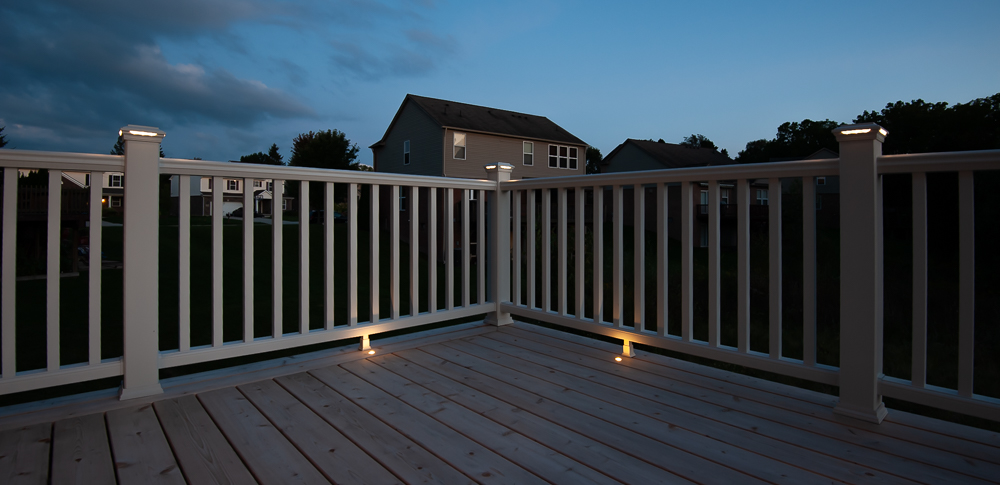
In-deck lights are mounted flush with the surface of the deck boards themselves, producing a soft ambient glow at ground level. They’re commonly used to define the perimeter of a deck (especially when there’s no railing), line a pathway, or accent a specific area like a sunken hot tub or fire table surround. Because they sit low and cast light outward and upward, they add a warm, layered quality to a deck’s evening atmosphere. They can also be used in stair treads as an alternative or complement to riser lights.
Post Cap Lights and Post Side Lights
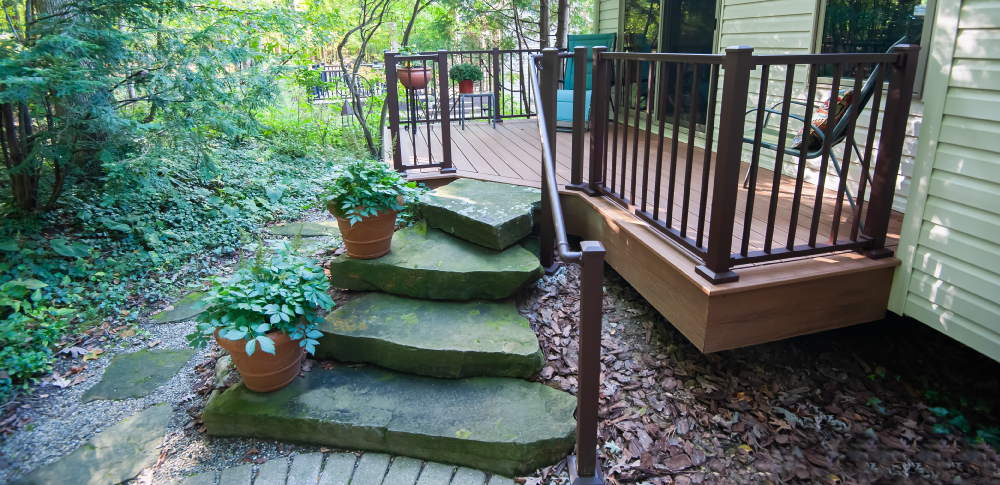
Post cap lights sit atop railing (newel) posts and cast a warm glow in all directions, illuminating the deck and surrounding yard at a comfortable height. They’re one of the most visually prominent lighting elements on a deck and are often the anchor of a lighting scheme. Post side lights (sometimes called accent lights) mount to the face or side of a post rather than the top, directing light downward along the post and onto the deck surface below. Both types are available to match most railing post profiles and powder-coat colors. Lighted rail posts or rail caps are often used to mark out the two posts at the top or bottom of a set of stairs.
Under-Rail Lights
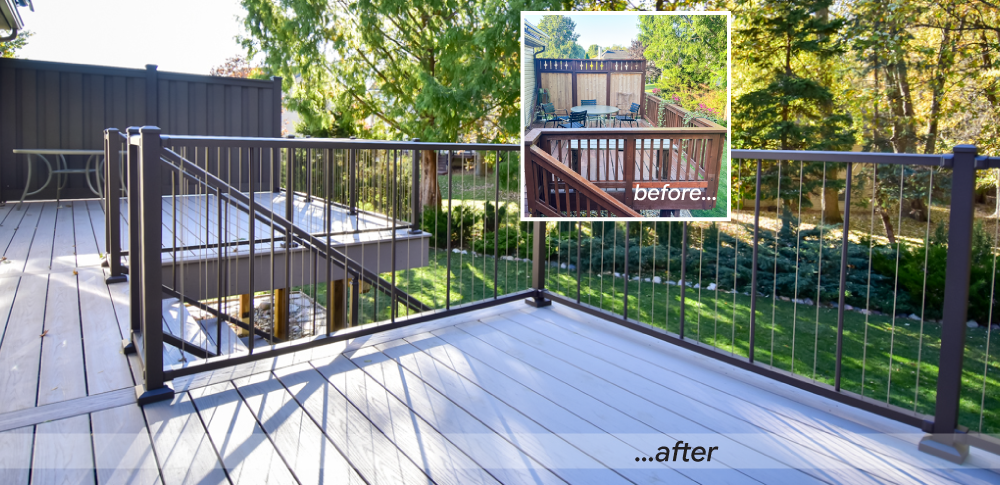
Under-rail lights mount into the top or bottom rail of a railing system, running along its length and casting a soft downward light onto the deck. They’re a linear, clean, architectural lighting element, and they work particularly well on longer rail runs where you want a consistent, defined glow along the railing. Not all railing systems allow for this style of rail lights. Feeney DesignRail allows for top and bottom rail lighting with their horizontal cable rail systems, so that’s a popular choice for many homeowners. It’s even possible to integrate lighting into natural wood top rails (like Ipe or cedar).
Custom Options: Task Lighting, Safety Floodlights, and Sconce Lighting
Beyond the standard deck lighting menu, there are custom options worth discussing for the right project. Task lighting (directional fixtures focused on a grill station, outdoor kitchen, or work surface) makes a covered cooking area genuinely functional after dark rather than just atmospheric. Safety floodlights on the house wall or an overhead structure can illuminate a larger area for security or practical use. Sconce lighting mounted to a privacy wall, pergola post, or house exterior adds an architectural quality that standard deck lights don’t provide. These options work best when they’re planned into the design from the start, not added afterward.
Ceiling Fans with Lights (Covered Decks and Porches)
If your deck is covered (a solid-roof pergola, a screened porch, or a roof-covered deck), a ceiling fan with an integrated light is one of the most practical investments you can make. In Michigan summers, the fan extends comfortable outdoor time by several degrees, and the overhead light provides broad, even illumination that railing-level fixtures can’t replicate. For covered outdoor spaces, this is the one lighting fixture we’d consider close to essential.
Lighting System Configurations
Low-Voltage Transformer Systems
The large majority of deck lighting we install runs on low-voltage (12V DC) transformer systems. A transformer plugs into a standard outdoor outlet and steps the household current down to a safe, low-voltage level that powers all the deck lights through a network of run wires. The benefits of this approach are significant: consistent, reliable light output regardless of weather or season, the ability to run multiple light types on one system, dimming capability, and timer or smart control integration. Installation requires some planning (wire runs need to be routed during the build for the cleanest result) but the performance over the life of the deck is hard to match.
Both Trex and TimberTech require their own branded transformers for warranty compliance, and their systems are designed as integrated ecosystems. Westbury’s Magena Star lighting system similarly uses a dedicated transformer and wiring system matched to their railing products. These transformers often feature dusk/dawn timers, remote controls, and other handy options.
The main limitation of a low-voltage system is that it requires an accessible outdoor outlet. If your deck doesn’t have one nearby, that’s no problem. We can factor adding one into the project scope and budget.
Solar Lights
Solar post cap lights and solar riser lights are a legitimate option for homeowners who want a simple, low-commitment lighting addition without running any wire. They charge during the day and activate automatically at dusk. Trex offers a solar option that’s popular for customers who require just a few post cap lights in a location that gets good daytime sun exposure.
The honest trade-offs: solar lights are dependent on sun exposure and perform noticeably less well on overcast days or in shaded yards, both of which are common in Washtenaw County. Light output is generally dimmer than low-voltage systems, and performance degrades as the battery ages over several years. For a primary lighting scheme, we’d steer most homeowners toward a transformer system. For a secondary accent or a location where running wire is genuinely impractical, solar is a reasonable choice.
Battery-Powered Systems
Battery-powered lights offer flexibility in placement (no wire runs, no outlet required) and are useful for accent locations or temporary setups. The limitations are similar to solar: output is lower than transformer systems, and the ongoing cost and inconvenience of battery replacement adds up over time. For permanent deck lighting, batteries are best treated as a supplement to a transformer system rather than the primary approach.
Lighting System Comparison
| Low-Voltage Transformer | Solar | Battery | |
|---|---|---|---|
| Light output | Consistent, dimmable | Variable (weather-dependent) | Moderate, declines as battery drains |
| Installation | Requires wire runs and outlet | No wiring needed | No wiring needed |
| Ongoing cost | Low (minimal electricity) | Low (battery replacement over time) | Ongoing battery cost |
| Best for | Primary lighting scheme | Accent or low-priority locations | Supplemental or temporary |
| Performance in cloudy weather | Unaffected | Reduced | Unaffected until battery drains |
| Smart controls / dimming | Yes (with compatible transformer) | Limited | Limited |
Brands We Install
Trex Outdoor Lighting
Trex’s lighting line covers a wide range of deck light types: riser lights, recessed in-deck lights, rail post accent lights, and post cap lights (including a solar cap option). All Trex lighting uses long-life Cree LEDs and runs on a 12V DC transformer system. A standout feature is the Trex LightHub plug-and-play connection system, which allows lights to be connected without splicing wires, making installation cleaner and more DIY-accessible than most systems. Trex lighting is designed to integrate visually with their composite decking and railing lines and is available in Charcoal Black, Classic White, and Bronze. If you’re building with Trex decking and railing, their lighting system is a natural fit for a cohesive finished look.
TimberTech Lighting
TimberTech’s lighting system, marketed under the DeckLites name, includes post cap light modules, in-deck lights, riser lights, under-rail lights, and accent lights. The system runs on 12V low-voltage and includes dimmable, Instant On fixtures with a 5-year limited warranty. A notable feature is the under-rail light, which produces a clean, hidden downlight effect between balusters that works particularly well with TimberTech’s Impression Rail systems. TimberTech’s lighting requires their branded transformer or PowerPack for warranty compliance. The product line is available in Matte White, Matte Black, Matte Espresso, and Architectural Bronze, coordinating well with their railing color palette.
Westbury (Magena Star) Lighting
Westbury’s lighting offering is the Magena Star line, produced by Digger Specialties and designed specifically to match Westbury aluminum railing in both form and finish. Magena Star includes low-voltage post cap lights, post side lights, and riser lights, all powder-coated to coordinate with Westbury’s railing colors and textures. The system uses a dedicated transformer and easy-plug wiring, and is available in both low-voltage and solar configurations. Because Westbury railing posts use a consistent 3-inch exterior profile, lighting components fit cleanly without adaptation. If your project includes Westbury aluminum railing, Magena Star is the logical lighting companion.
Feeney DesignRail Lighting
Feeney DesignRail–a customer favorite for its horizontal cable rail–offers modern, clean-lined under rail lighting strips that call out the deck’s perimeter with a subtle glow. Their 24V “Wet location” strip light has a weatherproof housing, and it features dimming capability. Feeney also offers side post lights (“accent lights”) that are wet rated and feature a beautiful, glowing 108 lumen output. The Feeney lighting options can be matched exactly to the railing finish options, including their custom colors.
What to Think About When Designing Your Lighting
A few considerations that help guide the design conversation:
Start with safety, then add ambiance. Steps and deck edges (especially for decks that have no railing) are the non-negotiable starting points. Riser lights on every stair run and some form of perimeter or post lighting to define the deck edge should be the baseline. From there, in-deck lights, under-rail lighting, and accent fixtures add atmosphere.
Think about how you use the deck. A deck used primarily for quiet evening dining has different lighting needs than one used for gatherings of twenty people. A cooking area benefits from task lighting. A hot tub surround benefits from perimeter in-deck lights. Knowing how you actually live in the space shapes the lighting design more than any other factor.
Plan the wiring during the build. Lighting added to an already existing deck almost always involves some compromise in wire routing. When lighting is planned from the start, wire runs can be hidden within the framing and posts for a completely clean result. In addition, an outdoor plug can be placed in the most useful location. If you’re building a new deck or resurfacing an existing one, the time to think about lighting is before the new deck boards go down (or the railing goes up).
Consider your yard’s sun exposure for solar. Shaded yards and overcast Michigan winters make solar a less dependable primary lighting system than in sunnier climates. This is worth factoring in early rather than discovering after installation. In Michigan, it’s a good idea to opt for wired lighting whenever possible.
Match your lighting to your decking and railing system. Each of the brands we install has a lighting line designed to coordinate with its own railing in both color and profile, so keeping the deck lighting within the same brand ecosystem as your railing is the way to go. If your deck doesn’t need any railing, we usually–but not always–propose a lighting system that’s of the same brand as your decking. If we’re installing a wood deck or wood railing, we may suggest one of a number of lighting systems to you.
How Ann Arbor Decks Approaches Lighting Design
Deck lighting is something we think about as part of the overall design, not as an afterthought. When we put together your proposal, a lighting package is included as a separate line item. That means you can see clearly how many lights we’re recommending, what types, and what the cost is, and you can adjust that package as you see fit. Want to add riser lights but skip the in-deck perimeter? We can do that. Want to upgrade to a full integrated system with dimming controls? We can do that too. The goal is a lighting plan that fits your deck, your yard, and your budget, built from the ground up to work with the materials you’ve chosen.
If you’re designing a new deck or wondering whether lighting makes sense for an existing one, we’re glad to walk through the options with you on-site.
Book your free consultation today. We serve Ann Arbor, Saline, Dexter, Chelsea, Pittsfield Township, Ypsilanti, and the surrounding Washtenaw County area.
Frequently Asked Questions
Does deck lighting require an electrician? Low-voltage transformer systems operate at 12V DC, which is well below the threshold requiring licensed electrical work for the lighting components themselves. The transformer plugs into a standard outdoor outlet. If you don’t have an outdoor outlet where you need one, adding one does require a licensed electrician and should be budgeted separately. We can help coordinate this if needed.
How many lights does a typical deck need? It depends heavily on deck size, configuration, and the type of lighting you want. A modest 300-square-foot deck with one stair run might have four riser lights, four to six post cap lights, and a handful of in-deck perimeter lights. A larger or more complex deck could have significantly more. The lighting package in your proposal will specify exactly what we’re recommending and why.
Can lighting be added to an existing deck? Yes, in most cases. The main consideration is wire routing. On an existing deck, wires may need to be surface-mounted in channels or run through existing post cavities rather than hidden within framing. The result is functional but sometimes less clean than lighting planned during a new build. We’ll tell you honestly what’s achievable on your specific deck during a consultation.
Do deck lights hold up in Michigan winters? Quality low-voltage LED fixtures are rated for outdoor use year-round and handle Michigan freeze-thaw cycles without issue. Trex and TimberTech lights use Cree LEDs in weather-resistant housings built for exactly these conditions. Solar lights in northern climates may underperform in winter months due to reduced daylight and sun angle, which is worth factoring into any solar decision.
What’s the difference between warm white and cool white LED lights? Warm white (around 2700-3000K color temperature) produces a soft, amber-tinged glow similar to incandescent light. It’s the more popular choice for residential decks because it looks inviting and relaxed, rather than clinical. Cool white (4000K and above) is brighter and more neutral, sometimes used in task lighting or commercial settings. Trex and TimberTech both use 3000K LEDs in their primary lighting products, which sit at the warmer end of the spectrum.