

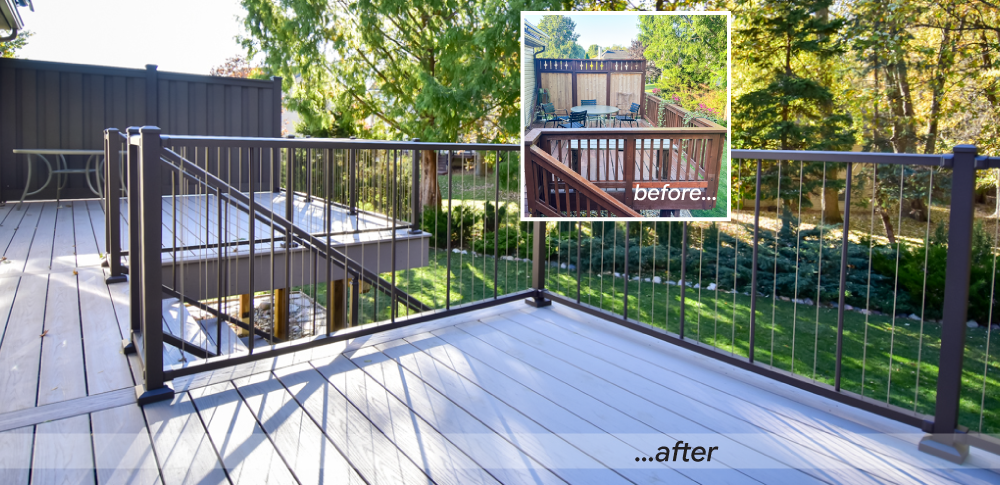
Resurface or Replace

Deck Resurfacing vs. Replacement: Which Is Right for Your Ann Arbor Area Home?

Highlights from this Article:

  • Resurfacing replaces the deck boards and railing on an existing frame. While most customers resurface with composite (to avoid wood maintenance), it's possible to resurface with wood as well.
  • Resurfacing is good option only if: A) the underlying structure is still sound, and B) the framing will last for the lifespan of the new decking you're putting onto it.
  • Putting new decking and/or railing on a sound existing deck frame will give you the look a brand-new deck.
  • Full deck replacement makes more sense when there's significant structural damage, post rot, or widespread joist failure. It's also the best choice if you want to change the deck layout in a significant way.
  • Rebuilding the deck is the way to go when the cost of rebuilding barely differs from the cost of resurfacing. However, resurfacing is usually less expensive.
  • Ann Arbor Decks evaluates every deck individually. Where repair is a realistic option, we present both choices. Where it isn't, we'll tell you honestly.

"Should I rebuild or resurface (reskin) my deck?"

It's one of the most common questions we hear at Ann Arbor Decks — and the honest answer is that it depends. There's no universal rule that applies to every deck in every backyard. What we can do is walk you through how we think about the decision, what we look for during an assessment, and what your realistic options are likely to be.

What Is Deck Resurfacing?

Resurfacing ("re-decking" or "reskinning") means removing and replacing the deck boards — and often the railing — while keeping the existing structural frame in place: the posts, beams, joists, and footings that hold everything up. If your frame is solid, resurfacing can give your outdoor space an essentially new look and feel at a meaningfully lower cost than a full teardown and rebuild. During a resurfacing project, we can do smaller repairs and joist replacements, and not infrequently we may replace a footing or even a beam. Another thing worth knowing upfront: if your deck has stairs, we typically rebuild them rather than resurface them.

At Ann Arbor Decks, resurfacing can take a few different forms depending on your situation.

  • Composite overlay on an existing wood frame: We remove your old decking and replace it with Trex or TimberTech composite or PVC, giving you a low-maintenance surface on a frame you don't have to replace. This is one of our most popular resurfacing approaches for decks whose frames are still in good shape.
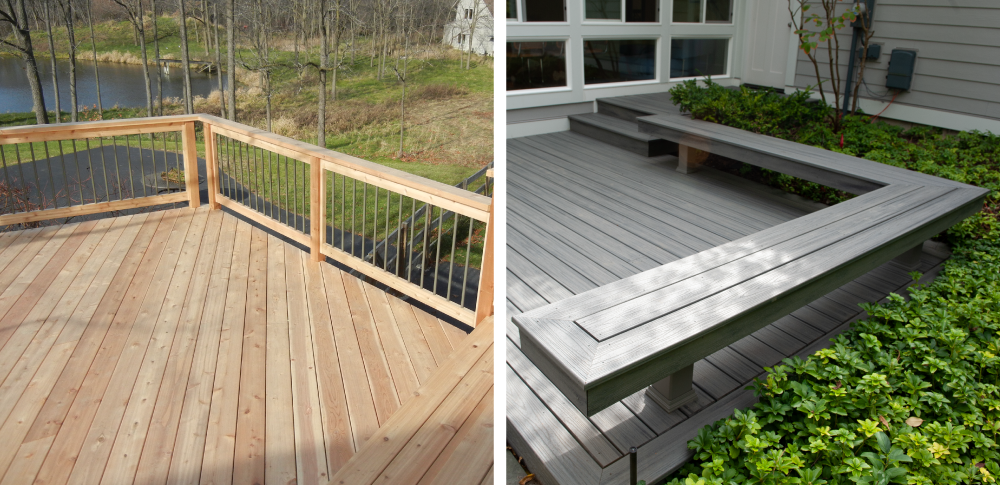
  • Wood-on-wood resurfacing: In cases where the substructure isn't too old and the homeowner prefers to stay with natural wood, we can resurface with new cedar or pressure-treated boards.

What Is Full Deck Replacement?

Full replacement means exactly what it sounds like: the existing deck comes down completely — decking, railing, framing, posts and footings — and a new deck is built from below the ground up. It's often (but not always) a larger investment than resurfacing, but it's the right call when the existing structure is no longer safe, or when the cost of repairing the frame approaches or exceeds the cost of starting fresh.

When we do a full replacement, we handle all demolition and disposal. Michigan requires that pressure-treated lumber be disposed of at an authorized facility — not burned or placed in regular trash — and we handle that responsibly on every job.

How We Assess Your Deck

During a free on-site consultation, our team walks your deck carefully — not just looking at the surface, but probing the structure underneath. Here's what we're evaluating:

Signs That Point Toward Resurfacing

  • Deck boards that are worn, cracked, splintered, or grayed — but structurally intact underneath
  • Railing that's cosmetically tired but attached to sound posts
  • A frame that's in good structural condition — generally under 15 years for a low-to-the-ground deck, potentially up to 20 to 25 years for an elevated deck with good airflow underneath
  • A deck that was originally well-built with quality materials

Signs That Point Toward Full Replacement

  • Post rot at ground level: When posts have rotted at or below the surface, the structural integrity of the deck is usually compromised. If the rot is isolated to one or two posts and footings while the rest of the frame is sound, we can replace those posts and footings as part of the resurfacing project. Widespread post rot, however, points toward full replacement.
  • Widespread joist damage: Soft, spongy, or visibly rotted joists mean the frame can't safely support new decking. Replacing a few joists is sometimes feasible; replacing most of them usually isn't cost-effective.
  • Soft or rotted decking throughout: When the deterioration is widespread rather than isolated, replacement is almost always the more sensible path.
  • Age — but with an important nuance: For a deck that sits close to the ground where moisture accumulates, we start looking very carefully at the framing once it reaches 15 to 20 years. For an elevated deck with good airflow underneath — which dries out more effectively after rain — a well-maintained frame may be a viable resurfacing candidate up to 20 to 25 years. Either way, age is a flag to assess closely, not an automatic verdict.

Our Honest Policy

At Ann Arbor Decks, we don't have a financial interest in steering you toward replacement when resurfacing is a realistic option — or toward resurfacing when your deck genuinely needs to come down. Our approach is straightforward:

  • If we assess your deck and believe a full rebuild is the only responsible recommendation, we'll tell you that and quote accordingly.
  • If we believe resurfacing is a viable option, we'll present both choices — resurfacing and full replacement — with clear pricing for each, and let you decide what makes sense for your home and budget.

We've been doing this since 2006. Our reputation in Washtenaw County is built on honest assessments and work that holds up over time, not on upselling jobs that don't need to be bigger than they are.

A Quick Guide: Resurfacing or Replacement?

Resurfacing Full Replacement
Frame condition Sound — no significant rot or damage Compromised — rot, soft spots, or widespread damage
Deck age Under 15–20 years (elevated decks with good airflow may qualify up to 20–25 years) 15–20+ years for low-to-ground decks; 20–25+ years for elevated decks
Post condition Solid at ground level, or isolated posts replaceable Widespread rot at or below grade
Joist condition Firm and structurally sound Soft, spongy, or widespread rot
Ledger board Sound, or repairable in isolation Severely damaged or causing moisture intrusion
Relative cost Lower Higher — but sometimes the only right answer
Result New surface, existing structure Entirely new deck, built to current standards

Frequently Asked Questions

Can I put composite decking over my existing wood deck boards? Not directly on top — the old boards need to come off first. But once we remove the existing decking, we can install composite boards on your existing frame, provided the frame passes our structural assessment. Many homeowners are pleasantly surprised to find their framing is in better shape than the worn surface suggested.

How long does a resurfaced deck last? That depends largely on what you resurface with. A composite surface installed on a sound frame will last 25 to 30 years with minimal maintenance. A wood resurfacing will last 15 to 25+ years with consistent care. In either case, the longevity of the resurfaced deck is ultimately tied to the health of the frame underneath — which is exactly why we assess it carefully before recommending resurfacing.

My deck is only 10 years old — do I really need to replace it? Age alone doesn't determine the answer. A 10-year-old deck that was poorly built or inadequately maintained may need replacement, while a 20-year-old deck with quality framing and consistent care might be an excellent resurfacing candidate. The only way to know for certain is an on-site assessment.

What happens to my old deck after you demolish it? We handle all demolition debris responsibly. Michigan requires that pressure-treated lumber be disposed of at an authorized facility — it cannot be burned or placed in household trash. Depending on the size of your project, we'll either use our own trailers to haul the material to an approved disposal site, or arrange for a dumpster service to handle it.

Is resurfacing always cheaper than replacing? Usually — but not always. When the framing requires significant repair alongside a new surface, the combined cost can approach or exceed a full replacement. That's one of the reasons we evaluate the full picture before quoting. We want you making a decision based on accurate numbers, not a low estimate that grows once we get into the work.

Let's Take a Look

If your deck is showing its age, the best first step is an honest, professional assessment. At Ann Arbor Decks, our on-site consultations are free, no-pressure, and typically take just 30 to 45 minutes. We'll walk your deck with you, tell you what we see, and give you a clear picture of your options — including a detailed written quote for whichever path makes sense.

Book your free estimate today. No pressure, no obligation — just a straightforward conversation about what your deck actually needs.
{ "@context": "https://schema.org", "@type": "FAQPage", "mainEntity": [ { "@type": "Question", "name": "Can I put composite decking over my existing wood deck boards?", "acceptedAnswer": { "@type": "Answer", "text": "Not directly on top. The existing deck boards need to be removed first. Once the old decking is taken off, composite boards can be installed on the existing frame provided the framing passes a structural assessment. In many cases, the framing underneath is still in good condition even when the deck surface has worn out." } }, { "@type": "Question", "name": "How long does a resurfaced deck last?", "acceptedAnswer": { "@type": "Answer", "text": "The lifespan depends largely on the material used for resurfacing. A composite surface installed on a sound frame can last 25 to 30 years with minimal maintenance. A wood resurfacing can last roughly 15 to 25 years with consistent care. In both cases, the longevity of the resurfaced deck depends heavily on the condition of the structural frame beneath it." } }, { "@type": "Question", "name": "My deck is only 10 years old — do I really need to replace it?", "acceptedAnswer": { "@type": "Answer", "text": "Age alone does not determine whether a deck needs replacement. A 10-year-old deck that was poorly built or inadequately maintained may need replacement, while a 20-year-old deck with quality framing and consistent care could be an excellent resurfacing candidate. The best way to know is through an on-site structural assessment." } }, { "@type": "Question", "name": "What happens to my old deck after you demolish it?", "acceptedAnswer": { "@type": "Answer", "text": "All demolition debris is handled responsibly. Michigan regulations require pressure-treated lumber to be disposed of at an authorized facility and it cannot be burned or placed in household trash. Depending on the size of the project, materials may be hauled to an approved disposal site using company trailers or removed using a dumpster service." } }, { "@type": "Question", "name": "Is resurfacing always cheaper than replacing?", "acceptedAnswer": { "@type": "Answer", "text": "Usually, but not always. If the framing requires significant repair alongside a new deck surface, the combined cost can approach or exceed a full replacement. For that reason, the framing and overall condition of the structure are evaluated before providing recommendations so homeowners can make a decision based on accurate numbers." } } ] }
Read more

Composite vs Wood Decking

Composite vs. Wood Decks: Which Material Is Right for Your Ann Arbor Home?

Highlights from this article:

  • Composite decking (like Trex or TimberTech) can cost more up front, but it rewards with low maintenance, strong warranties, and lasting good looks.
  • Natural wood (pine, cedar, Ipe) costs less to start and offers authentic beauty, but requires regular staining, painting, and sealing to hold up over time.
  • Both can last 25+ years. The difference is in the amount of upkeep along the way.

Skip down to the quick comparison table or the FAQs.

You’ve decided it’s time to build (or rebuild) a deck. Or perhaps you’re considering resurfacing and repairing an existing deck. Now comes the big question: What type of decking should I use? Composite or wood?

The two most popular choices are natural wood (pine, cedar, Ipe) or composite decking (like Trex, TimberTech or Deckorators). Both have genuine strengths and weaknesses. The right choice depends on your up front budget, how you live, how much maintenance you’re willing to do, and the importance natural wood may hold for the style and look of your home. Let’s walk through it together.

What Is Composite Decking? What is PVC decking?

Composite decking is an engineered product, often made from a blend of wood fiber and recycled plastics. PVC decking is extruded poly vinyl chloride (PVC) that is usually capped with a rigid, plastic shell. Trex and TimberTech are probably the best-known brands, but Deckorators is another excellent option we work with at Ann Arbor Decks. These engineered materials resist the things that shorten the life of a natural wood deck: moisture, UV exposure, insects, and everyday wear.

Composite deck boards hold their color and structure through Michigan’s wide seasonal swings, without the need to sand, seal or paint. All they require is simple cleaning with gentle soaps to last for decades.

What Are the Natural Wood Decking Options?

Wood decking comes in several varieties, each with its own character:

  • Pressure-Treated Pine is the most budget-friendly and widely available option. It holds up well when properly maintained, making it a practical choice for homeowners who are cost-conscious upfront.
  • Cedar is naturally resistant to insects and decay, and it has a beautiful, warm and knotty appearance that many homeowners love. It’s a step up in both price and aesthetics.
  • Ipe (pronounced “ee-pay”) is a dense Brazilian hardwood that’s remarkably durable — often lasting 40 years or more with proper care. It’s one of the most beautiful decking materials available, with a rich, dark grain that can be maintained with oiling, or weather to a distinguished silver if left untreated.

One more thing worth considering: your yard’s sun exposure. Wood thrives in sunny, well-ventilated backyards where it can dry out after rain. In shady or consistently damp yards, wood stays wet longer — accelerating mold, warping, and decay. If your deck site doesn’t get much sun, composite (which is effectively waterproof) may be the smarter long-term choice.

Upfront Cost Comparison

The idea that composite always costs significantly more than wood deserves a closer look. Pressure-treated pine remains the most affordable decking option upfront. However, the large composite brands are making great strides when it comes to price competition.

Several composite lines (like Trex Enhance, for example) are priced in line with cedar, often coming in at a similar cost per square foot installed. When you add the fact that composite skips the annual maintenance bills that wood demands, the composite decking value proposition gets even more attractive.

The conclusion: While treated pine wins on upfront cost, composite and mid-grade wood are priced closer than most homeowners expect.

Maintenance

This is where composite really earns its reputation. A Trex or TimberTech deck needs little more than an occasional wash with soap and water. Treated pine and cedar, on the other hand, must be cleaned, sanded, and re-stained or sealed every one to three years to prevent cracking, warping, and graying. Ipe (if not sealed) should be oiled. That’s real time and real money — year after year.

If you’d rather spend your weekends on your deck than working on it, composite is worth serious consideration.

Appearance

Natural wood has a warmth and authenticity that’s hard to replicate. If the organic beauty of real grain and texture matters deeply to you — especially with cedar or Ipe — wood may be your preference. Also, wood can be painted any custom color you choose, unlike composite deck boards, which can’t be painted.

Composite manufacturers have made enormous strides in mimicking natural wood grain, and today’s composite options are genuinely attractive. But they aren’t quite the same as the real thing. Some lines of composite decking feature deeper and more obvious wood grain texture, and some feature smoother grains. Both are popular, but current trends seem to favor the smoother, more neutral colors of composite decking.

Longevity

A well-maintained composite deck can last 25 to 30 years. A quality wood deck, properly cared for, can last just as long — but the properly cared for part is where many homeowners find the gap. In Michigan’s climate, neglected wood decks deteriorate faster than you’d expect.

Warranty Coverage

Composite decking backs its promises with manufacturer warranties. Trex covers fading, staining, and material defects for 25 years, and TimberTech offers comparable protection (30 year limited warranty) on its premium lines. TimberTech’s PVC lines (which are 100% plastic) have 50 year fade and stain warranties.

Natural wood carries no manufacturer’s warranty from Mother Nature.

So Which Should You Choose?

There’s no single right answer — but here’s a simple way to think about it:

  • Choose composite if you want a low-maintenance, long-lasting deck that looks great year after year without much effort on your part. It’s an especially smart choice for families with young children, dog owners, or anyone who simply wants to enjoy their deck rather than maintain it.
  • Choose wood if you love the natural character of real timber, want to keep upfront costs lower, or are drawn to the distinctive beauty of a material like Ipe or cedar. Just go in with clear eyes about the maintenance commitment — it’s manageable, but it’s real.

Quick Comparison: Composite vs. Wood

Composite (Trex / TimberTech) Natural Wood (Pine, Cedar, Ipe)
Upfront Cost Higher Lower
Maintenance Very low — occasional cleaning only Regular staining/sealing required every 1–3 years
Appearance Realistic wood look; consistent color Authentic natural grain and warmth; can be painted any color
Longevity 25–30 years 25+ years with proper care (Ipe 40+ years)
Warranty 25-year manufacturer warranty (varies by brand/line) None
Splinter Risk None Possible over time without maintenance
Best For Low-effort ownership; families; Michigan weather resilience Natural aesthetics; lower upfront budget

Frequently Asked Questions

Is composite decking really worth the higher upfront cost?
For many Ann Arbor homeowners, yes — especially when you factor in the long-term picture. Composite decking eliminates the annual maintenance costs of staining, sealing, and sanding that wood requires. When you add up those recurring expenses over 10 or 15 years, the upfront price difference often narrows considerably. Entry-level composite lines like Trex Enhance are also competitively priced with cedar, so the gap may be smaller than you expect from the start.

How long does a composite deck last compared to a wood deck?
A quality composite deck typically lasts 25 to 30 years. A well-maintained wood deck can last just as long — but the emphasis is on well-maintained. In Michigan’s climate, where freeze-thaw cycles, humidity, and heavy snow loads stress outdoor structures, wood that doesn’t receive consistent care tends to deteriorate fast.

Which wood species holds up best in Michigan’s climate?
Pressure-treated pine is the most affordable choice and performs well with consistent maintenance. Cedar and Ipe both perform well in Michigan’s conditions. Cedar’s natural oils resist insects and moisture, making it a durable mid-range option. Ipe is exceptionally dense and hard — it handles Michigan winters admirably — but it requires occasional oiling to maintain its appearance and prevent surface cracking.

Can I add composite decking to an existing wood frame?
In many cases, yes. Composite decking boards can be installed over an existing pressure-treated frame, provided the frame is structurally sound and the joist spacing meets the composite manufacturer’s specifications. An on-site assessment is the best way to determine whether your existing framing and footings are a good candidate for resurfacing — something we’re happy to evaluate during a free consultation.

Does my backyard’s sun exposure really affect which material I should choose?
More than most homeowners realize. Wood decks in shady, damp yards stay wet (or snowy) much longer, which accelerates mold, warping, and decay. If your deck site doesn’t get much direct sun, composite is likely the smarter long-term investment — it handles moisture far more reliably than natural wood.

We’ll Help You Find Your Answer

At Ann Arbor Decks, we’ve been building decks across Washtenaw County since 2006 — in pressure-treated pine, cedar, Ipe, Trex, TimberTech, Deckorators and more. We’ve seen how each material performs over time in Michigan’s specific climate, and we love helping homeowners match the right material to their lifestyle and budget.

Our on-site consultations are free, no-pressure, and typically take just 45 minutes. We’ll come to your home, listen to your vision, and give you a clear, honest picture of your options — including a detailed written quote.

Ready to start the conversation? Book your free estimate today.

{ "@context": "https://schema.org", "@type": "FAQPage", "mainEntity": [ { "@type": "Question", "name": "Is composite decking really worth the higher upfront cost?", "acceptedAnswer": { "@type": "Answer", "text": "For many Ann Arbor homeowners, yes — especially when you factor in the long-term picture. Composite decking eliminates the annual maintenance costs of staining, sealing, and sanding that wood requires. When you add up those recurring expenses over 10 or 15 years, the upfront price difference often narrows considerably. Entry-level composite lines like Trex Enhance are also competitively priced with cedar, so the gap may be smaller than you expect from the start." } }, { "@type": "Question", "name": "How long does a composite deck last compared to a wood deck?", "acceptedAnswer": { "@type": "Answer", "text": "A quality composite deck typically lasts 25 to 30 years. A well-maintained wood deck can last just as long, but the emphasis is on well-maintained. In Michigan's climate, where freeze-thaw cycles, humidity, and heavy snow loads stress outdoor structures, wood that does not receive consistent care tends to deteriorate more quickly." } }, { "@type": "Question", "name": "Which wood species holds up best in Michigan's climate?", "acceptedAnswer": { "@type": "Answer", "text": "Pressure-treated pine is the most affordable choice and performs well with consistent maintenance. Cedar and Ipe both perform well in Michigan's conditions. Cedar's natural oils resist insects and moisture, making it a durable mid-range option. Ipe is exceptionally dense and hard and handles Michigan winters well, though it requires occasional oiling to maintain its appearance and prevent surface cracking." } }, { "@type": "Question", "name": "Can I add composite decking to an existing wood frame?", "acceptedAnswer": { "@type": "Answer", "text": "In many cases, yes. Composite decking boards can be installed over an existing pressure-treated frame, provided the frame is structurally sound and the joist spacing meets the composite manufacturer's specifications. An on-site assessment is the best way to determine whether your existing framing and footings are a good candidate for resurfacing." } }, { "@type": "Question", "name": "Does my backyard's sun exposure really affect which material I should choose?", "acceptedAnswer": { "@type": "Answer", "text": "More than most homeowners realize. Wood decks in shady, damp yards stay wet or snowy much longer, which accelerates mold, warping, and decay. If your deck site does not get much direct sun, composite is often the smarter long-term investment because it handles moisture far more reliably than natural wood." } } ] }
Read more

Deck Building Process

Steps to Building a New Deck in Washtenaw County: What Is the Process?

Highlights from this Article:

  • Building a new deck involves several steps, and a good contractor will manage most of them on your behalf.
  • Ann Arbor Decks handles the permit application process for every project. You don’t have to navigate municipal offices yourself.
  • Permitting timelines vary widely across Washtenaw County municipalities. We factor this into the project schedule from the start.
  • If your neighborhood has an HOA, their approval typically needs to come before the municipal permit (something worth knowing early).
  • Every Ann Arbor Decks project comes with a written timeline at signing so you know what to expect and when.

Skip down to the process overview table or the FAQs.

While most deck builds are not too complicated, the process isn’t just about framing and decking. There’s design work, HOA approval, zoning and permitting, material lead times, inspections, and sequencing to coordinate. Done well, most of that happens in the background and you experience it as a smooth, well-managed project.

This post walks through the process we follow at Ann Arbor Decks for every new build, so you know what to expect before you pick up the phone.

Step 1: Initial Consultation

Every project starts with a free on-site consultation, typically 45 minutes. We come to your home, walk the space with you, and talk through what you’re envisioning (size, materials, railing style, any special features like built-in lighting, a pergola, or an outdoor kitchen area).

We’re also looking at the site itself during this visit: grade, existing landscaping, how the deck will attach to the house, access for equipment and materials, and anything else that affects how the project gets designed and built. A deck that looks simple on paper sometimes has site conditions that require additional planning. We’d rather find those things at the consultation than mid-build.

After the consultation, we put together a written quote with clear, itemized pricing. No vague estimates. You’ll see what you’re paying for.

Step 2: Design and Drawings

Once you decide to move forward, we produce design drawings for your deck in-house. These aren’t rough sketches: they’re the detailed drawings that go to the municipality with your permit application, showing dimensions, framing layout, footing locations and sizes, ledger attachment detail, and railing specifications.

We’ll review your deck design with you first, so you have the opportunity to make adjustments while changes are still easy. This is also when we finalize material selections if you haven’t already.

Step 3: Material Selection

If you haven’t settled on materials by the end of the consultation, the design phase is when we nail that down. The main decisions are decking surface (composite or wood, and which product line), railing system, and any special features. We can walk you through samples and help you think through what suits your home, your yard, and your maintenance preferences.

Material lead times vary. Most standard composite products are readily available, but custom colors, specialty railing systems, or pergola kits may have longer lead times that affect the project schedule. We factor this in when we give you your build timeline.

Step 4: HOA Approval (If Applicable)

If your neighborhood has a homeowners association, their approval typically needs to come before you can apply for a municipal building permit. HOA review processes vary considerably. Some associations turn around approvals in a week or two; others meet only quarterly and require submissions well in advance of their meeting dates.

If you have an HOA, let us know at the consultation. We can provide the drawings and documentation their review board typically requires, but the submission and approval process runs through you as the homeowner. We’ve found it’s worth understanding your HOA’s timeline early, as it can be the longest single variable in the pre-construction phase.

Step 5: Permit Application

Ann Arbor Decks handles the building permit application for every project. You don’t need to visit municipal offices or navigate the application yourself. We take care of it.

If you need Ann Arbor historical permissions, that is something you would need to obtain first. We can assist you in any way possible.

Washtenaw County encompasses many Townships and municipalities, and permitting timelines vary more than most homeowners expect. The City of Ann Arbor, Saline, Dexter, Chelsea, Pittsfield Township, Ypsilanti, and the surrounding townships each have their own building departments with their own review processes and workloads. Some turn permits around in a week or two; others can take considerably longer, particularly during the busy spring and summer building season.

A few things that affect permitting in this area:

  • Zoning setbacks vary by municipality. How close your deck can be to a property line, easement, or structure depends on local zoning rules. Where possible, we obtain zoning approval before submitting your permit, so there are no setback surprises after the permit is filed.
  • Deck drawings must meet Michigan Residential Code requirements. Our in-house drawings are prepared with code compliance in mind, which helps avoid revision requests that delay permit issuance.
  • Permit fees vary by municipality and project scope. These are passed through to you at cost, plus our administrative fees. The permit costs will be clearly broken out for you on your contract.

Step 6: Site Preparation

Once the permit is in hand, we can more exactly schedule your project start date. If there’s an existing deck or structure being removed, demolition and debris hauling happens first. We handle all of that, including proper disposal of any pressure-treated lumber, which Michigan requires be taken to an authorized facility rather than placed in regular trash.

We also arrange to have Miss Dig mark utility lines before any digging begins. In Michigan, this means we call MISS DIG (dial 811) to have underground utilities located and flagged. This is a legal requirement before any excavation and a step we take seriously. Hitting an unmarked utility line is dangerous and costly. When flags show up in your lawn, you’ll need to leave them be until we remove them for you.

Step 7: Footings and Framing

This is the structural core of your deck, and it’s where the quality of a build is really established, even though most of it ends up hidden once the decking goes down.

In Michigan, deck footings must extend below the frost line, which is 42 inches. This prevents the freeze-thaw cycle from heaving posts out of the ground over time (a common cause of deck instability on improperly built structures). We pour concrete footings to the required depth and allow appropriate cure time before framing begins. The inspector will come out to approve the size, position and depth of the holes (the ‘footings inspection’).

Framing involves setting posts, installing beams and joists, and attaching the ledger board to the house. If your deck is ledgered (not all decks are attached), this ledger connection is one of the most structurally critical details in any attached deck, and we take care with both the attachment method and the flashing that protects your home’s rim joist from water intrusion. A ledger that allows water behind it is a slow-motion problem that doesn’t show up until significant damage has already occurred.

Depending on your municipality, a framing inspection may be required before decking can be installed. Where required, we schedule and coordinate this inspection.

Step 8: Decking and Railing Installation

With framing complete and inspection passed, decking boards go down. Hidden fastener systems (which leave a clean surface with no visible screw heads) are standard on most of our composite installations. Stair construction, if your deck includes stairs, happens during this phase as well.

Railing installation follows. Whether you’ve chosen cable, glass, aluminum balusters, or a composite system, this is when the deck starts to look finished. We pay attention to detail at this stage (consistent spacing, plumb posts, secure connections) because the railing is both a safety system and one of the most visible design elements of the finished deck.

Step 9: Final Inspection

A final building inspection takes place before the permit is closed out. An inspector from the local building department visits the site and reviews the completed deck against the approved permit drawings and applicable code requirements, like stair riser heights, stair widths, and stair handrail requirements. We schedule and coordinate this inspection for you.

Once final inspection is passed, the permit is closed and the deck is officially yours to enjoy.

The Process at a Glance

StepWho Handles ItNotes
1. Initial consultationAnn Arbor DecksFree, on-site, 30–45 minutes
2. Design and drawingsAnn Arbor DecksReviewed with homeowner before submission
3. Material selectionHomeowner (with our guidance)Affects lead times and project schedule
4. HOA approvalHomeowner (we provide documentation)Required before permit in many neighborhoods; timelines vary
5. Permit applicationAnn Arbor DecksTimelines vary by municipality
6. Site preparationAnn Arbor DecksIncludes demolition, MISS DIG, utility marking
7. Footings and framingAnn Arbor Decks42″ frost-depth footings required in Michigan
8. Decking and railingAnn Arbor DecksHidden fasteners standard on composite installations
9. Final inspectionAnn Arbor Decks (schedules and coordinates)Required by most Washtenaw County municipalities

Frequently Asked Questions

Do I need a permit to build a deck in Washtenaw County? In virtually all cases, yes. Any attached deck (and most freestanding decks above a certain size) requires a building permit in Washtenaw County municipalities. Building without a permit creates problems when you sell your home and can result in costly remediation if the unpermitted structure is discovered. Ann Arbor Decks handles the permit application for every project we build.

How long does the whole process take from first call to finished deck? It varies by project, but the permitting phase is usually the longest variable. Once a permit is in hand, the active build time for your specific deck is something we are happy to provide. We also coordinate with you on your expected project start date, staying in good communication as the project approaches.

What if my HOA rejects the design? We work with you to adjust the design to meet HOA requirements and resubmit. Most HOA rejections involve aesthetic concerns (materials, colors, or height) that can be addressed without fundamentally changing the project. The important thing is to start the HOA process early so a revision doesn’t significantly delay the overall timeline.

What is MISS DIG and why does it matter? MISS DIG is Michigan’s underground utility notification service. Before any digging begins, Michigan law requires contractors to contact MISS DIG (by dialing 811) so that underground utilities (gas, electric, water, communications lines) can be located and marked. We handle this as a standard part of every project requiring digging, before excavation starts. MISS DIG won’t cover sprinkler lines, so we do ask that you have your landscaper move those before we start work, if possible.

Why do footings need to go 42 inches deep? Michigan’s frost line (the depth at which the ground freezes in winter) is 42 inches. Footings that don’t extend below the frost line are subject to frost heave, where freezing and thawing soil pushes the footing (and the post above it) up and out of position over time. This leads to decks that become unlevel, unstable, or structurally compromised. Frost-depth footings are required by code and are simply the right way to build in Michigan.

Can I start using my deck before the final inspection? Technically the deck isn’t permitted for occupancy until the final inspection is passed and the permit is closed. We schedule final inspections promptly at project completion. There’s no reason for this step to take long once the work is done.

Ready to Get Started?

If you’re thinking about a new deck, the best first step is a conversation. Our free on-site consultations are no-pressure, take about 30 to 45 minutes, and give you a clear picture of what your project would involve. We then follow up with a written quote and a realistic timeline.

Book your free estimate today. We serve Ann Arbor, Saline, Dexter, Chelsea, Pittsfield Township, Ypsilanti Township, and the surrounding Washtenaw County area.

{ "@context": "https://schema.org", "@type": "FAQPage", "mainEntity": [ { "@type": "Question", "name": "Do I need a permit to build a deck in Washtenaw County?", "acceptedAnswer": { "@type": "Answer", "text": "In virtually all cases, yes. Any attached deck, and most freestanding decks above a certain size, requires a building permit in Washtenaw County municipalities. Building without a permit can create problems when you sell your home and can result in costly remediation if the unpermitted structure is discovered. Ann Arbor Decks handles the permit application for every project we build." } }, { "@type": "Question", "name": "How long does the whole process take from first call to finished deck?", "acceptedAnswer": { "@type": "Answer", "text": "It varies by project, but the permitting phase is usually the longest variable. Once a permit is in hand, we are happy to provide the active build time for your specific deck. We also coordinate with you on your expected project start date and stay in good communication as the project approaches." } }, { "@type": "Question", "name": "What if my HOA rejects the design?", "acceptedAnswer": { "@type": "Answer", "text": "We work with you to adjust the design to meet HOA requirements and resubmit. Most HOA rejections involve aesthetic concerns such as materials, colors, or height that can be addressed without fundamentally changing the project. The important thing is to start the HOA process early so a revision does not significantly delay the overall timeline." } }, { "@type": "Question", "name": "What is MISS DIG and why does it matter?", "acceptedAnswer": { "@type": "Answer", "text": "MISS DIG is Michigan's underground utility notification service. Before any digging begins, Michigan law requires contractors to contact MISS DIG by dialing 811 so that underground utilities such as gas, electric, water, and communications lines can be located and marked. We handle this as a standard part of every project requiring digging before excavation starts. MISS DIG does not cover sprinkler lines, so we ask that your landscaper move those before work starts if possible." } }, { "@type": "Question", "name": "Why do footings need to go 42 inches deep?", "acceptedAnswer": { "@type": "Answer", "text": "Michigan's frost line, the depth at which the ground freezes in winter, is 42 inches. Footings that do not extend below the frost line are subject to frost heave, where freezing and thawing soil pushes the footing and the post above it up and out of position over time. This can lead to decks that become unlevel, unstable, or structurally compromised. Frost-depth footings are required by code and are the right way to build in Michigan." } }, { "@type": "Question", "name": "Can I start using my deck before the final inspection?", "acceptedAnswer": { "@type": "Answer", "text": "Technically, the deck is not permitted for occupancy until the final inspection is passed and the permit is closed. We schedule final inspections promptly at project completion, and there is usually no reason for this step to take long once the work is done." } } ] }
Read more