

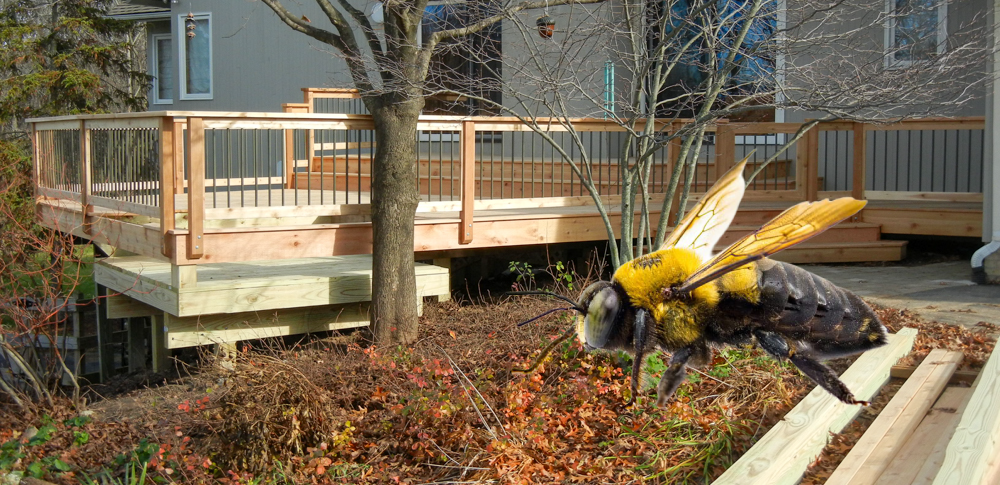
Carpenter Bees

Carpenter Bees Damaging Your Old Wood Deck or Gazebo? Here Are Some Solutions.

Highlights from this Article:

  • Carpenter bee damage to cedar decks, railings, posts, and gazebos is increasingly common across Washtenaw County. Our crew sees it on job sites year-round.
  • Unsealed, unpainted, or weathered cedar is the most vulnerable. Properly finished wood is significantly more resistant.
  • Damage often goes unaddressed for months or years. By which point the structural impact can be serious.
  • Composite decking is immune to carpenter bees. For homeowners who’ve dealt with repeated damage, resurfacing with composite is often the right long-term answer.

Skip down to the wood vs. composite comparison or the FAQs.

Our owner, Josiah Shurtliff, has been building decks in the Ann Arbor area since 2006. Over the past several years, he and our crew have noticed a pattern that’s hard to ignore. Carpenter bee damage to wood decks, railings, posts, and backyard structures is showing up more frequently, and by the time most homeowners call us, it’s been going on longer than they realized.

Here’s how to recognize carpenter bee damage, why cedar is particularly vulnerable, what it means for your deck structurally, and what your options are when you find damage.

What Carpenter Bees Actually Do

Carpenter bees are large, heavy-bodied bees that look similar to bumblebees. Unlike bumblebees, they don’t live in colonies. The females bore into wood to create individual nesting galleries. The entry hole is almost perfectly round, about half an inch in diameter (the size of a small coin, and typically appears on the underside or end grain of a board where it’s less exposed to weather.

Once inside, the bee turns and tunnels with the grain of the wood, sometimes extending several feet. That tunnel becomes a nesting chamber. The momma bee lays eggs, seals the chamber, and the next generation emerges the following spring, often returning to the same structure to bore new tunnels nearby. Year after year, the damage compounds.

There’s a secondary damage problem that many homeowners don’t know about: woodpeckers. Once carpenter bee larvae are established inside a piece of wood, woodpeckers will hammer into it to get at them. A post or railing that a carpenter bee has been working on for a season or two can end up looking like it lost a fight with a power drill (holes, splits, and splintered wood that goes well beyond the original bee entry points).

Why Cedar Is So Vulnerable

Cedar is a beautiful decking material and naturally rot-resistant, but it has a well-known vulnerability to carpenter bees: when it’s left bare, weathered, or inadequately finished, it’s one of their preferred targets. Carpenter bees strongly prefer untreated, unpainted, unfinished softwood, and cedar that hasn’t been properly sealed, stained, or painted is essentially an open invitation.

This is something Josiah and our crew see repeatedly on assessments. A homeowner puts in a cedar deck, enjoys it for a season or two, and either skips the initial finishing or lets it lapse. Within a few years, the railings and posts are dotted with entry holes. By the time we’re called out, the damage has often spread well beyond the surface boards into the posts and structural framing, components that are harder and more expensive to replace than decking or fascia.

Pressure-treated pine is less attractive to carpenter bees due to the chemical treatment, but it’s not entirely immune, particularly on older decks where the treatment has weathered and the wood has dried out and cracked.

Why Homeowners Often Don’t Act Quickly

We get carpenter bee damage calls year-round, but the actual damage happens in spring when female bees are most active. The reason we hear from homeowners in every season is that most people don’t act on it right away.

Part of that is the nature of the damage itself. The entry holes are small and sometimes in locations that aren’t immediately obvious (on the underside of a rail cap, at the base of a post, on the fascia boards that frame the deck’s edge). A homeowner might notice a hole or two, assume it’s minor, and intend to deal with it later. Meanwhile the bees are extending their tunnels, laying eggs, and the woodpeckers are following.

By the time “later” arrives, what might have been a resurfacing project has become a structural repair or a full replacement. We’re not saying this to alarm anyone. We’re saying it because catching damage early genuinely matters, and we’d rather see people act on it sooner than wait.

What We Find on Assessments

When we’re called out for a consultation, here’s what we’re looking at:

  • Deck boards and railings: Entry holes, surface damage, and softness or sponginess in the wood around affected areas.
  • Posts: Posts are a particular concern because they’re structural. A post that’s been extensively tunneled can lose significant load-bearing capacity. We probe posts carefully, especially at the base and cap where bees tend to concentrate.
  • Ledger board and framing: If bees have been active long enough, we check whether the damage has reached the framing. This is where things get more serious structurally.
  • Gazebos and pergolas: We’re seeing a lot of carpenter bee damage on gazebos and wood pergolas, particularly on exposed rafter tails, posts, and any bare cedar or pine components. These structures often get less maintenance attention than the main deck.

Your Options When You Find Damage

Full Resurfacing with Composite

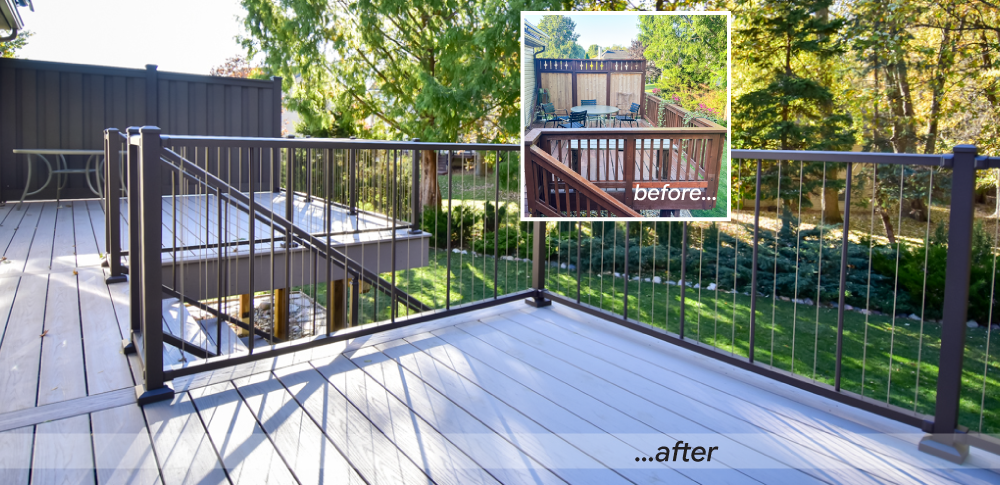
For homeowners who have dealt with significant carpenter bee damage, or who simply don’t want to deal with the ongoing maintenance and vulnerability of wood, resurfacing with composite decking is the most permanent solution. Composite boards are made from wood fiber and plastic; carpenter bees have no interest in boring into them. A composite deck surface, composite or PVC railings, and properly treated or composite post systems eliminate the carpenter bee problem for the life of the deck.

We’ve done a number of these projects in Washtenaw County where the trigger was exactly this: a cedar deck with recurring carpenter bee damage, a homeowner who’s tired of fighting it, and a decision to resurface with composite once and not think about it again. It’s a sound investment, particularly when the framing is still in good shape and a full replacement isn’t necessary.

Repair and Refinish the Existing Wood

Where the damage is caught early and the structural framing is sound, homeowners can replace damaged boards, repair or replace affected posts, fill existing holes, and refinish the wood with a quality paint or solid stain. Properly finished cedar (well-sealed and maintained) is significantly more resistant to carpenter bees than bare or weathered wood.

This is a viable path, but it comes with an honest caveat: it requires follow-through on maintenance. If the deck goes bare again, the bees will be back. We’ll tell you this plainly when we give you your options.

Wood vs. Composite: Carpenter Bee Vulnerability at a Glance

Bare or Weathered Cedar Properly Finished Cedar Composite Decking
Carpenter bee risk High Moderate (requires upkeep) None
Maintenance required Immediate Regular sealing and staining Minimal
Structural risk if ignored Significant over time Lower with proper maintenance Not applicable
Long-term solution No Only with consistent upkeep Yes

Frequently Asked Questions

How do I know if I have carpenter bee damage? Look for round entry holes approximately half an inch in diameter, typically on the underside of horizontal boards, the tops of rail caps, or the faces of posts. You may also see coarse sawdust (called frass) below entry points, or yellow staining from bee waste near holes. If woodpeckers have been active on your deck or pergola, that’s another strong indicator. They’re usually following the bees.

Are carpenter bees dangerous to people? Generally no. Male carpenter bees can be territorial and will hover aggressively near their nesting sites, but they have no stinger. Female carpenter bees do have stingers but are docile and rarely sting unless directly handled. The danger is to your wood structures, not to you.

Can I treat the existing holes myself? You can fill holes with wood filler or steel wool and caulk as a temporary measure, and insecticide dust applied to active holes in spring can kill larvae before they emerge. But DIY treatment addresses the symptom, not the underlying vulnerability. Bare, unfinished wood will attract new bees the following season. If the damage is more than superficial, a professional assessment is worth it.

Does composite decking really eliminate the problem? For the deck surface and composite or PVC railing components, yes. Carpenter bees bore into wood fiber; they have no interest in composite or PVC materials. If your post system uses wood posts (even on a composite deck), those should be addressed. We can discuss post options during a consultation.

How quickly does carpenter bee damage become a structural problem? It depends on the scope of activity and how long it’s been going on. A single season of moderate activity on a few boards is usually a surface issue. Several seasons of heavy activity on posts or framing members can meaningfully compromise structural integrity. This is why we encourage homeowners not to wait once they notice it.

Is this a problem specific to the Ann Arbor area? Carpenter bees are common throughout the eastern United States, but our crew has noticed an uptick in damage calls across Washtenaw County over the past several years. Whether that reflects a growing bee population, more wood decks reaching the age where unsealed wood becomes attractive, or simply greater awareness, we can’t say for certain. What we can say is that it’s a real and growing part of what we’re seeing on assessments in this area.

Think You Might Have Carpenter Bee Damage?

If you’ve noticed holes in your deck railings, posts, or backyard structures, it’s worth having someone take a look before the next spring season brings another round of activity. Our free on-site assessments take about 30 to 45 minutes, and we’ll give you a clear, honest picture of what we find along with your options.

Book your free assessment today. We serve Ann Arbor, Saline, Dexter, Chelsea, Pittsfield Township, Ypsilanti, and the surrounding Washtenaw County area.
{ "@context": "https://schema.org", "@type": "FAQPage", "mainEntity": [ { "@type": "Question", "name": "How do I know if I have carpenter bee damage?", "acceptedAnswer": { "@type": "Answer", "text": "Look for round entry holes approximately half an inch in diameter, often on the underside of horizontal boards, the tops of rail caps, or the faces of posts. You may also see coarse sawdust called frass below entry points or yellow staining from bee waste near holes. Woodpecker activity around the area can also indicate carpenter bees, since the birds often target the larvae." } }, { "@type": "Question", "name": "Are carpenter bees dangerous to people?", "acceptedAnswer": { "@type": "Answer", "text": "Generally no. Male carpenter bees may hover aggressively near nesting sites but do not have stingers. Female carpenter bees do have stingers but are typically docile and rarely sting unless directly handled. The primary concern is damage to wooden structures rather than risk to people." } }, { "@type": "Question", "name": "Can I treat the existing holes myself?", "acceptedAnswer": { "@type": "Answer", "text": "You can fill holes with wood filler or steel wool and caulk as a temporary measure. Insecticide dust applied to active holes in spring can kill larvae before they emerge. However, DIY treatment usually addresses the symptom rather than the underlying vulnerability. Bare or unfinished wood often attracts new bees the following season." } }, { "@type": "Question", "name": "Does composite decking eliminate carpenter bee problems?", "acceptedAnswer": { "@type": "Answer", "text": "For deck surfaces and composite or PVC railing components, yes. Carpenter bees bore into wood fiber and generally ignore composite and PVC materials. If wood posts are still used in the structure, those areas may still attract bees and should be addressed separately." } }, { "@type": "Question", "name": "How quickly does carpenter bee damage become a structural problem?", "acceptedAnswer": { "@type": "Answer", "text": "It depends on the level and duration of activity. A single season of moderate activity in a few boards is usually a surface issue. Several seasons of heavy activity in posts or framing members can compromise structural integrity. It is best to evaluate the damage early before it progresses." } }, { "@type": "Question", "name": "Is carpenter bee damage specific to the Ann Arbor area?", "acceptedAnswer": { "@type": "Answer", "text": "Carpenter bees are common throughout the eastern United States. However, contractors in the Ann Arbor and Washtenaw County area have noticed an increase in damage calls in recent years. This may be due to population growth, aging wood decks with unsealed surfaces, or simply greater awareness among homeowners." } } ] }
Read more

Resurface or Replace

Deck Resurfacing vs. Replacement: Which Is Right for Your Ann Arbor Area Home?

Highlights from this Article:

  • Resurfacing replaces the deck boards and railing on an existing frame. While most customers resurface with composite (to avoid wood maintenance), it's possible to resurface with wood as well.
  • Resurfacing is good option only if: A) the underlying structure is still sound, and B) the framing will last for the lifespan of the new decking you're putting onto it.
  • Putting new decking and/or railing on a sound existing deck frame will give you the look a brand-new deck.
  • Full deck replacement makes more sense when there's significant structural damage, post rot, or widespread joist failure. It's also the best choice if you want to change the deck layout in a significant way.
  • Rebuilding the deck is the way to go when the cost of rebuilding barely differs from the cost of resurfacing. However, resurfacing is usually less expensive.
  • Ann Arbor Decks evaluates every deck individually. Where repair is a realistic option, we present both choices. Where it isn't, we'll tell you honestly.

"Should I rebuild or resurface (reskin) my deck?"

It's one of the most common questions we hear at Ann Arbor Decks — and the honest answer is that it depends. There's no universal rule that applies to every deck in every backyard. What we can do is walk you through how we think about the decision, what we look for during an assessment, and what your realistic options are likely to be.

What Is Deck Resurfacing?

Resurfacing ("re-decking" or "reskinning") means removing and replacing the deck boards — and often the railing — while keeping the existing structural frame in place: the posts, beams, joists, and footings that hold everything up. If your frame is solid, resurfacing can give your outdoor space an essentially new look and feel at a meaningfully lower cost than a full teardown and rebuild. During a resurfacing project, we can do smaller repairs and joist replacements, and not infrequently we may replace a footing or even a beam. Another thing worth knowing upfront: if your deck has stairs, we typically rebuild them rather than resurface them.

At Ann Arbor Decks, resurfacing can take a few different forms depending on your situation.

  • Composite overlay on an existing wood frame: We remove your old decking and replace it with Trex or TimberTech composite or PVC, giving you a low-maintenance surface on a frame you don't have to replace. This is one of our most popular resurfacing approaches for decks whose frames are still in good shape.
  • Wood-on-wood resurfacing: In cases where the substructure isn't too old and the homeowner prefers to stay with natural wood, we can resurface with new cedar or pressure-treated boards.

What Is Full Deck Replacement?

Full replacement means exactly what it sounds like: the existing deck comes down completely — decking, railing, framing, posts and footings — and a new deck is built from below the ground up. It's often (but not always) a larger investment than resurfacing, but it's the right call when the existing structure is no longer safe, or when the cost of repairing the frame approaches or exceeds the cost of starting fresh.

When we do a full replacement, we handle all demolition and disposal. Michigan requires that pressure-treated lumber be disposed of at an authorized facility — not burned or placed in regular trash — and we handle that responsibly on every job.

How We Assess Your Deck

During a free on-site consultation, our team walks your deck carefully — not just looking at the surface, but probing the structure underneath. Here's what we're evaluating:

Signs That Point Toward Resurfacing

  • Deck boards that are worn, cracked, splintered, or grayed — but structurally intact underneath
  • Railing that's cosmetically tired but attached to sound posts
  • A frame that's in good structural condition — generally under 15 years for a low-to-the-ground deck, potentially up to 20 to 25 years for an elevated deck with good airflow underneath
  • A deck that was originally well-built with quality materials

Signs That Point Toward Full Replacement

  • Post rot at ground level: When posts have rotted at or below the surface, the structural integrity of the deck is usually compromised. If the rot is isolated to one or two posts and footings while the rest of the frame is sound, we can replace those posts and footings as part of the resurfacing project. Widespread post rot, however, points toward full replacement.
  • Widespread joist damage: Soft, spongy, or visibly rotted joists mean the frame can't safely support new decking. Replacing a few joists is sometimes feasible; replacing most of them usually isn't cost-effective.
  • Soft or rotted decking throughout: When the deterioration is widespread rather than isolated, replacement is almost always the more sensible path.
  • Age — but with an important nuance: For a deck that sits close to the ground where moisture accumulates, we start looking very carefully at the framing once it reaches 15 to 20 years. For an elevated deck with good airflow underneath — which dries out more effectively after rain — a well-maintained frame may be a viable resurfacing candidate up to 20 to 25 years. Either way, age is a flag to assess closely, not an automatic verdict.

Our Honest Policy

At Ann Arbor Decks, we don't have a financial interest in steering you toward replacement when resurfacing is a realistic option — or toward resurfacing when your deck genuinely needs to come down. Our approach is straightforward:

  • If we assess your deck and believe a full rebuild is the only responsible recommendation, we'll tell you that and quote accordingly.
  • If we believe resurfacing is a viable option, we'll present both choices — resurfacing and full replacement — with clear pricing for each, and let you decide what makes sense for your home and budget.

We've been doing this since 2006. Our reputation in Washtenaw County is built on honest assessments and work that holds up over time, not on upselling jobs that don't need to be bigger than they are.

A Quick Guide: Resurfacing or Replacement?

Resurfacing Full Replacement
Frame condition Sound — no significant rot or damage Compromised — rot, soft spots, or widespread damage
Deck age Under 15–20 years (elevated decks with good airflow may qualify up to 20–25 years) 15–20+ years for low-to-ground decks; 20–25+ years for elevated decks
Post condition Solid at ground level, or isolated posts replaceable Widespread rot at or below grade
Joist condition Firm and structurally sound Soft, spongy, or widespread rot
Ledger board Sound, or repairable in isolation Severely damaged or causing moisture intrusion
Relative cost Lower Higher — but sometimes the only right answer
Result New surface, existing structure Entirely new deck, built to current standards

Frequently Asked Questions

Can I put composite decking over my existing wood deck boards? Not directly on top — the old boards need to come off first. But once we remove the existing decking, we can install composite boards on your existing frame, provided the frame passes our structural assessment. Many homeowners are pleasantly surprised to find their framing is in better shape than the worn surface suggested.

How long does a resurfaced deck last? That depends largely on what you resurface with. A composite surface installed on a sound frame will last 25 to 30 years with minimal maintenance. A wood resurfacing will last 15 to 25+ years with consistent care. In either case, the longevity of the resurfaced deck is ultimately tied to the health of the frame underneath — which is exactly why we assess it carefully before recommending resurfacing.

My deck is only 10 years old — do I really need to replace it? Age alone doesn't determine the answer. A 10-year-old deck that was poorly built or inadequately maintained may need replacement, while a 20-year-old deck with quality framing and consistent care might be an excellent resurfacing candidate. The only way to know for certain is an on-site assessment.

What happens to my old deck after you demolish it? We handle all demolition debris responsibly. Michigan requires that pressure-treated lumber be disposed of at an authorized facility — it cannot be burned or placed in household trash. Depending on the size of your project, we'll either use our own trailers to haul the material to an approved disposal site, or arrange for a dumpster service to handle it.

Is resurfacing always cheaper than replacing? Usually — but not always. When the framing requires significant repair alongside a new surface, the combined cost can approach or exceed a full replacement. That's one of the reasons we evaluate the full picture before quoting. We want you making a decision based on accurate numbers, not a low estimate that grows once we get into the work.

Let's Take a Look

If your deck is showing its age, the best first step is an honest, professional assessment. At Ann Arbor Decks, our on-site consultations are free, no-pressure, and typically take just 30 to 45 minutes. We'll walk your deck with you, tell you what we see, and give you a clear picture of your options — including a detailed written quote for whichever path makes sense.

Book your free estimate today. No pressure, no obligation — just a straightforward conversation about what your deck actually needs.

{ "@context": "https://schema.org", "@type": "FAQPage", "mainEntity": [ { "@type": "Question", "name": "Can I put composite decking over my existing wood deck boards?", "acceptedAnswer": { "@type": "Answer", "text": "Not directly on top. The existing deck boards need to be removed first. Once the old decking is taken off, composite boards can be installed on the existing frame provided the framing passes a structural assessment. In many cases, the framing underneath is still in good condition even when the deck surface has worn out." } }, { "@type": "Question", "name": "How long does a resurfaced deck last?", "acceptedAnswer": { "@type": "Answer", "text": "The lifespan depends largely on the material used for resurfacing. A composite surface installed on a sound frame can last 25 to 30 years with minimal maintenance. A wood resurfacing can last roughly 15 to 25 years with consistent care. In both cases, the longevity of the resurfaced deck depends heavily on the condition of the structural frame beneath it." } }, { "@type": "Question", "name": "My deck is only 10 years old — do I really need to replace it?", "acceptedAnswer": { "@type": "Answer", "text": "Age alone does not determine whether a deck needs replacement. A 10-year-old deck that was poorly built or inadequately maintained may need replacement, while a 20-year-old deck with quality framing and consistent care could be an excellent resurfacing candidate. The best way to know is through an on-site structural assessment." } }, { "@type": "Question", "name": "What happens to my old deck after you demolish it?", "acceptedAnswer": { "@type": "Answer", "text": "All demolition debris is handled responsibly. Michigan regulations require pressure-treated lumber to be disposed of at an authorized facility and it cannot be burned or placed in household trash. Depending on the size of the project, materials may be hauled to an approved disposal site using company trailers or removed using a dumpster service." } }, { "@type": "Question", "name": "Is resurfacing always cheaper than replacing?", "acceptedAnswer": { "@type": "Answer", "text": "Usually, but not always. If the framing requires significant repair alongside a new deck surface, the combined cost can approach or exceed a full replacement. For that reason, the framing and overall condition of the structure are evaluated before providing recommendations so homeowners can make a decision based on accurate numbers." } } ] }
Read more