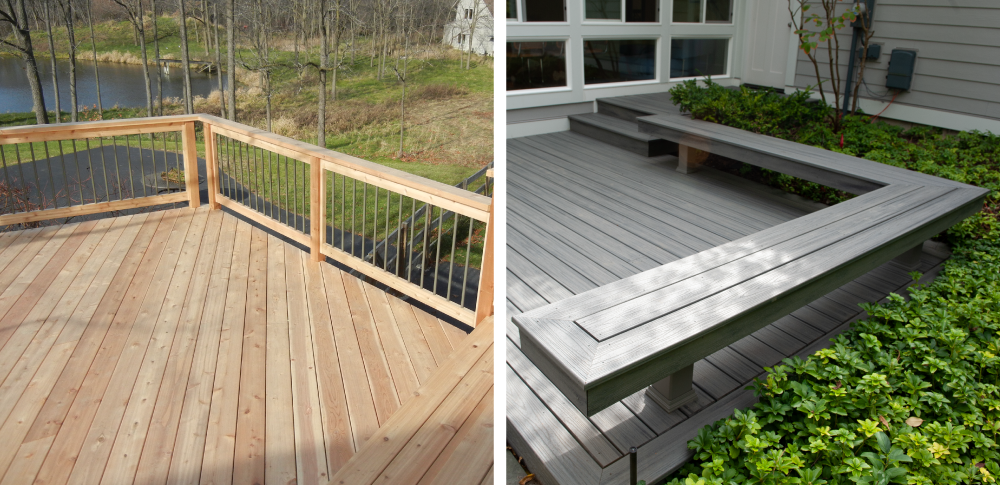

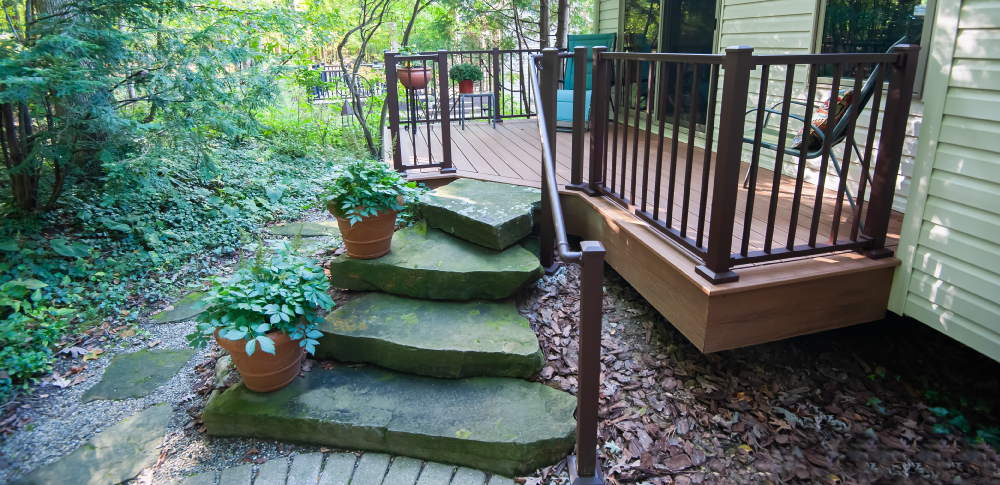
Environmental Sustainability: What’s Better, Wood or Composite Decking?
Highlights from this article:
- Both natural wood decking and composite decking carry trade-offs, so the most environmentally responsible choice depends on which one you value the most.
- Composite decking uses recycled materials (waste wood and used plastics), and it lasts longer. On the flip side, it takes more energy to produce, and it cannot itself be recycled.
- Wood decking is long-lasting, biodegradable, carbon-storing, and renewable — but most types require chemical stains or paints for maintenance and longevity.
- Pressure-treated pine, like composite decking, must be disposed of in a landfill at the end of its usable life.
Skip down to the quick comparison table or the FAQs.
You’ve decided to build a deck. You care about the environment. Now comes a question that’s more complicated than it looks: Which decking material is actually better for the planet?
Both wood and composite decking have genuine environmental strengths, and both carry real environmental costs. What we can do is lay out the trade-offs honestly, so you can make the choice that best reflects your values.
Wood Decking: Natural, Renewable — and Not Without Trade-Offs
Cedar: The Environmentally Friendlier Wood Option
Cedar is one of the most ecologically responsible choices in the wood decking category. Cedar trees grow relatively quickly, and responsible forestry practices — including certification from the Forest Stewardship Council (FSC) — ensure that harvested trees are replanted, often at rates of 10 to 20 saplings per tree logged. The FSC-certified cedar used by Ann Arbor Decks means you’re supporting forests actively managed for long-term sustainability.
Cedar also brings a meaningful end-of-life advantage: it biodegrades. When a cedar deck eventually reaches the end of its useful life, it returns to the earth (a fate composite decking cannot share).
On the carbon side, wood has a compelling story. Trees absorb carbon dioxide as they grow, and that carbon stays locked in the wood throughout the life of your deck. A 2025 life-cycle analysis found that softwood lumber actually has a negative carbon impact, meaning that its use in construction reduces atmospheric carbon rather than adding to it.
The honest downside: Cedar still requires logging, transportation, and periodic maintenance — including staining and sealing products that carry their own chemical footprint.
Pressure-Treated Pine: The Chemical Question
Pressure-treated ("PT") pine’s environmental story has improved significantly over the past two decades. Until 2004 (two years before Ann Arbor Decks had our start), virtually all residential PT lumber was treated with Chromated Copper Arsenate (CCA) — a preservative containing arsenic. Happily, the EPA and the lumber industry phased out CCA for residential use, replacing it with safer alternatives like Alkaline Copper Quaternary (ACQ) and Copper Azole.
Today’s PT pine is meaningfully better, especially when disposed of properly. The larger environmental case for PT pine is its longevity. The same chemicals that raise concern are what allow a fast-growing, affordable species to serve as a long-lasting building material, reducing how many trees need to be harvested over time.
The honest downside: Disposing of old PT lumber requires care. Never burn it, as the smoke can release toxic compounds. The State of Michigan requires us to dispose of PT pine at an authorized location. You can rest assured that if we’re demolishing your existing deck to rebuild it, we will ethically and legally dispose of the waste substructure, decking, and railing.
Composite and PVC Decking: Recycled Content, Petroleum Origins
The Recycled Content Argument
The environmental case for composite decking starts with what it’s made of. TimberTech boards incorporate 60% to 85% recycled materials. Trex manufactures its decking from up to 95% recycled and reclaimed content — sawdust, reclaimed wood fiber, and recycled polyethylene film.
Trex has evolved its plastic sourcing over time. The company now relies heavily on clear polyethylene shrink wrap (commercial pallet wrapping) rather than the consumer plastics like grocery bags that it originally used when it pioneered its deck product. It’s a smart shift: pallet wrap is generated in enormous volumes and has very limited recycling options in conventional waste streams. Trex alone diverts more than one billion pounds of plastic film from landfills every year.
Composite decking’s low-maintenance nature also has environmental implications. It never needs staining, sealing, or chemical treatments — a meaningful reduction in the maintenance chemicals most wood decks require over a 25-year lifespan.
The End-of-Life Problem
The wood fiber and plastic components in composite decking are currently inseparable, making the material impossible to recycle with today’s technology. Unlike wood decking, composite does not biodegrade. So, when a composite deck on a treated pine frame ends its life, both the treated pine and the composite elements must be disposed of in a landfill together.
How the Two Compare: An Environmental Lens
| Cedar | Pressure-Treated Pine | Composite (Trex/TimberTech) | PVC Decking | |
|---|---|---|---|---|
| Renewable Resource | Yes (if FSC-certified) | Yes (fast-growing species) | No | No |
| Recycled Content | No | No | Up to 95% | Varies |
| Carbon Storage | Yes — stores carbon throughout its life | Yes | No net benefit | No net benefit |
| Chemical Concerns | Low (natural oils) | Moderate (copper leaching) | Low in use | Higher (PVC production) |
| Biodegradable | Yes | Yes (slowly) | No | No |
| Recyclable at End of Life | Yes (can be repurposed or composted) | With care (no burning) | No — landfill only | No — landfill only |
| Maintenance Chemicals | Requires periodic staining/sealing | Requires periodic sealing | None | None |
| Longevity | 25+ years with care | 15–25 years with care | 25–30 years | 25–30 years |
Which Choice Is Right for the Environmentally Conscious Homeowner: Cedar, PT Pine or Composite?
Choose FSC-certified cedar if renewable resources, carbon storage, and end-of-life biodegradability matter most. Cedar from a responsibly managed forest grows back, stores carbon while it lives, and returns to the earth when it’s done. The trade-off is ongoing maintenance and a shorter lifespan without consistent care.
Choose composite if diverting plastic from landfills and eliminating long-term maintenance chemicals are your priorities. Composite makes a real and tangible environmental contribution — the trade-off is petroleum origins and a landfill destination at end of life.
Choose pressure-treated pine if affordability and renewable sourcing are your primary concerns and you’re committed to responsible maintenance and disposal. Today’s PT pine is a far cry from the arsenic-treated lumber of previous decades — but be mindful of its chemical footprint near water.
A Note on Certification
Look for the FSC logo on wood products. It guarantees the wood came from a forest managed for long-term sustainability — with replanting requirements, habitat protections, and supply chain accountability. Not all cedar or pine on the market meets this standard, but it’s available if you ask for it.
What the FSC Labels Mean | Forest Stewardship Council
For composite products, Trex and TimberTech both publish environmental data and third-party audit results worth reviewing if you want to dig deeper into a manufacturer’s claims.
Trex® Environmental Sustainability
Frequently Asked Questions
Is composite decking environmentally friendly? It’s genuinely complicated. Composite’s use of recycled materials meaningfully diverts plastic and wood waste from landfills — a real benefit. However, the plastic originates as a petroleum byproduct, and composite boards can’t be recycled at end of life. Whether that trade-off feels "green" depends on which environmental values you weigh most heavily.
Is pressure-treated pine safe for the environment today? Much safer than it used to be. The arsenic-based CCA treatment standard until 2004 has been replaced with less toxic alternatives like ACQ and Copper Azole. These still contain copper that can leach into soil, particularly in the first few years and in poorly drained areas. Never burn old PT lumber, and check local guidelines for disposal.
Which decking material has the smallest carbon footprint? Wood has a surprisingly strong carbon story. Trees store carbon as they grow, and that carbon stays locked in the wood throughout your deck’s life. A 2025 UNECE life-cycle analysis found softwood lumber delivers a net reduction in atmospheric carbon. Composite manufacturing involves energy-intensive extrusion and carries a net positive carbon footprint, though Trex and others have made meaningful strides in reducing production emissions.
Can I recycle my composite deck boards when I eventually replace them? Not with current technology. The wood fiber and plastic are fused together and can’t be separated for recycling — composite boards go to a landfill at end of life. The industry is working toward next-generation recycling solutions, but none are widely available yet.
How does Ann Arbor Decks dispose of my old deck and deck railing? At Ann Arbor Decks by JMJ, we’re committed to careful and proper disposal of your old deck’s footings, framing, decking, fascia and railing. Depending on the size and scope of your job, we may either A) use our own trailers to collect and dispose of your old deck at an approved landfill, or B) hire a dumpster service to take care of that for you.
What does FSC certification mean for wood decking? The Forest Stewardship Council certifies forests managed for long-term sustainability — with verified replanting practices, habitat protections, and supply chain accountability. Asking specifically for FSC-certified cedar or pine is the most reliable way to ensure your wood came from a responsible source.
We’ll Help You Think It Through
At Ann Arbor Decks, we don’t think there’s a single right answer to the wood-versus-composite question — including when the environment is part of the conversation. We’ve been helping Washtenaw County families build beautiful, lasting outdoor spaces since 2006, and we genuinely enjoy helping homeowners find the material that fits their values, their lifestyle, and their budget.
If environmental impact matters to your decision, bring it up during your consultation. We’ll give you an honest picture of your options so you can make a choice you feel good about for years to come.
Book your free estimate today. No pressure, no obligation — just a real conversation about what matters to you.